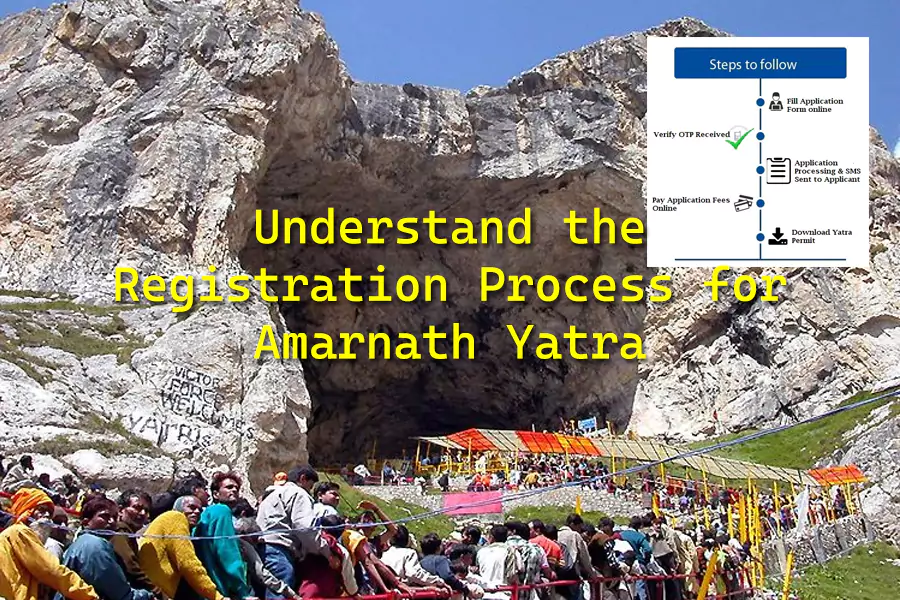

Amarnath Yatra 2026 Opening Dates! Check details

How to Book Kailash Mansarovar Yatra Tour Online?

Kailash Mansarovar Yatra Packages

Are you dreaming of visiting the holy Mount Kailash and sacred Mansarovar Lake? You are not alone! Every year, thousands of devotees from across India and the world plan their Kailash Mansarovar Yatra to seek blessings and experience spiritual peace. At Shrine Yatra, we make your dream journey simple, safe, and smooth. In this blog, we will guide you step by step on how to book a Kailash Mansarovar Yatra tour online without any trouble.

What is Kailash Mansarovar Yatra?

Kailash Mansarovar Yatra is one of the most sacred pilgrimages in the world. Pilgrims travel to Mount Kailash, which Hindus, Buddhists, Jains, and Bon followers all consider holy. Mansarovar Lake sits near the mountain and holds great religious importance. Taking a dip in this lake and completing the Parikrama (circumambulation) of Mount Kailash brings spiritual merit and inner peace to devotees.

The yatra takes you through some of the most beautiful landscapes on Earth. You cross high mountain passes, walk through valleys, and witness breathtaking views of snow-capped peaks. The journey is challenging but deeply rewarding for every pilgrim.

Why Book Kailash Mansarovar Yatra Online with Shrine Yatra?

Booking your Kailash Mansarovar Yatra online with Shrine Yatra gives you many benefits. Here is why thousands of pilgrims trust us every year:

Easy and Fast Booking Process

You can book your yatra from the comfort of your home. Our online portal is simple to use, and the entire booking process takes only a few minutes.

Transparent Pricing

We show you all costs clearly upfront. We do not hide any charges. You know exactly what you pay for.

Expert Guidance

Our team at Shrine Yatra has years of experience in organizing Kailash Mansarovar tours. We guide you at every step, from booking to returning home safely.

Trusted and Reliable

We have helped thousands of pilgrims complete their Kailash Mansarovar Yatra successfully. Our reviews and testimonials speak for themselves.

Complete Tour Packages

We offer complete packages that include transport, accommodation, meals, permits, and guide services. You do not need to worry about anything.

Types of Kailash Mansarovar Yatra Tour Packages

At Shrine Yatra, we offer different Kailash Mansarovar Yatra tour packages to suit different budgets and preferences. Below are the main options we provide:

1. Kailash Mansarovar Yatra via Lhasa (Tibet Route)

This is the most popular route for the Kailash Mansarovar Yatra. Pilgrims fly to Lhasa, the capital of Tibet, and then travel by road to Mount Kailash. This route is comfortable and gives pilgrims more time to acclimatize to the high altitude.

Highlights of this route:

  • Visit to Lhasa monasteries and temples
  • Drive through the beautiful Tibetan plateau
  • Comfortable road journey to Kailash
  • Shorter walking distances

2. Kailash Mansarovar Yatra via Kathmandu (Nepal Route)

This route starts from Kathmandu, Nepal. Pilgrims fly to Kathmandu and then travel by helicopter or road to the Tibet border and onward to Mount Kailash. This is a great option for those who want to explore Nepal as part of their journey.

Highlights of this route:

  • Visit to famous temples in Kathmandu
  • Scenic journey through Nepal and Tibet
  • Option to travel by helicopter for faster access
  • Suitable for all age groups with helicopter service

3. Kailash Mansarovar Yatra by Helicopter

For pilgrims who cannot do long treks or walks, we offer a Kailash Mansarovar Yatra by helicopter. This option reduces physical strain and allows more people to complete this sacred pilgrimage comfortably. The helicopter gives you aerial views of the stunning Himalayan landscape.

4. Budget Kailash Mansarovar Yatra Package

We also offer budget-friendly packages for pilgrims who want to complete the yatra without spending too much. These packages cover all essential requirements at affordable prices.

Step-by-Step Guide: How to Book Kailash Mansarovar Yatra Tour Online?

Now let us walk you through the complete process of booking your Kailash Mansarovar Yatra tour online with Shrine Yatra. Follow these simple steps and complete your booking with ease.

Step 1: Visit the Shrine Yatra Website

Open your internet browser and go to the official Shrine Yatra website. Our website is mobile-friendly, so you can easily access it on your smartphone too. On the homepage, you will see all the available Kailash Mansarovar Yatra packages listed clearly.

Step 2: Choose Your Preferred Tour Package

Browse through our different Kailash Mansarovar Yatra tour packages. Compare the routes, prices, duration, and inclusions. Select the package that best fits your needs, budget, and travel dates. If you feel confused, our team is always ready to help you choose the right package.

Step 3: Check the Available Travel Dates

Once you select your package, check the available departure dates. We offer multiple departure dates throughout the yatra season, which generally runs from May to September. Pick a date that works best for you and your group.

Step 4: Fill in Your Personal Details

Click on the “Book Now” button and fill in your personal information. You will need to provide:

  • Full name (as per passport)
  • Date of birth
  • Nationality
  • Passport number and validity
  • Contact number and email address
  • Emergency contact details

Make sure you enter all details correctly, as any mistake can cause issues with permits and travel documents.

Step 5: Upload Required Documents

The Kailash Mansarovar Yatra requires specific permits and documents. During the online booking process, you will need to upload:

  • Passport copy (valid for at least six months from travel date)
  • Recent passport-sized photographs
  • Any medical fitness certificate (if required for your chosen route)

Our team at Shrine Yatra will verify your documents and inform you if anything is missing.

Step 6: Select Add-On Services (Optional)

After filling in your details, you can choose from various add-on services we offer. These include:

  • Travel insurance
  • Single room accommodation
  • Extra nights in Kathmandu or Lhasa
  • Porter services during the trek
  • Oxygen cylinder arrangements

These add-ons make your journey more comfortable and safe.

Step 7: Review Your Booking Details

Before making the payment, review all the booking details carefully. Check the package name, travel dates, passenger details, and total cost. If you find any error, correct it before proceeding.

Step 8: Make the Online Payment

Once you confirm all the details, proceed to the payment section. We accept multiple payment options including:

  • Credit cards and debit cards
  • Net banking
  • UPI and mobile wallets
  • Bank transfers

Our payment gateway is fully secure, so you can pay with complete confidence.

Step 9: Receive Your Booking Confirmation

After successful payment, we send you a booking confirmation email and SMS within a few hours. This confirmation includes your booking reference number, tour details, and a list of things to do next.

Step 10: Connect with Our Yatra Expert

After booking, one of our dedicated Kailash Mansarovar Yatra experts will contact you. They will guide you on everything from physical preparation to packing lists, visa requirements, and pre-departure meetings.

Documents Required for Kailash Mansarovar Yatra

Pilgrims need to arrange several important documents before starting their Kailash Mansarovar Yatra. Here is a simple list of what you need:

For Indian Nationals:

  • Valid Indian passport (minimum six months validity)
  • Tibet Travel Permit (we arrange this for you)
  • Chinese Visa (we assist with this too)
  • Alien Travel Permit

For Foreign Nationals:

  • Valid passport
  • Tibet Group Visa
  • Chinese Visa
  • Any country-specific travel documents

At Shrine Yatra, our team handles most of the permit and visa process on your behalf. We make the paperwork simple and stress-free.

Best Time to Book Kailash Mansarovar Yatra Tour Online

The Kailash Mansarovar Yatra season runs from May to September each year. We strongly recommend that you book your tour at least three to four months in advance. Early booking helps you:

  • Secure your preferred travel dates
  • Get early bird discounts on packages
  • Have enough time to gather all required documents
  • Prepare physically for the high-altitude trek

Spots fill up quickly because this pilgrimage is very popular. Book early with Shrine Yatra to avoid missing out.

Physical Requirements and Health Tips for Kailash Mansarovar Yatra

The Kailash Mansarovar Yatra takes you to extremely high altitudes, sometimes above 19,000 feet. Your body needs to be in good condition to handle this. Here are some health tips every pilgrim should follow:

Start Walking Daily

At least two months before the yatra, start walking for 30 to 45 minutes every day. Gradually increase your walking time and speed. This helps your body prepare for the long treks.

Consult Your Doctor

Visit your doctor and get a complete health checkup before booking your yatra. People with heart problems, high blood pressure, or breathing issues need special medical advice before attempting this journey.

Stay Hydrated

Drink plenty of water during the yatra. High-altitude areas cause faster dehydration, so carry a water bottle everywhere and drink regularly.

Avoid Alcohol and Smoking

Pilgrims should avoid alcohol and smoking before and during the yatra. These habits reduce your body’s ability to handle high altitudes.

Pack the Right Gear

Carry warm clothes, sturdy trekking shoes, a first aid kit, sunscreen, lip balm, and any personal medicines you need.

What Does Shrine Yatra’s Kailash Mansarovar Package Include?

When you book a Kailash Mansarovar Yatra tour with Shrine Yatra, here is what we include in our standard packages:

  • Round-trip airfare (from specified departure city)
  • All accommodation on twin-sharing basis
  • All meals (breakfast, lunch, and dinner) during the tour
  • All transportation as per the itinerary
  • Experienced English and Hindi-speaking guides
  • Tibet Travel Permits and necessary documentation support
  • Medical oxygen cylinders at high-altitude locations
  • Porterage during the Parikrama
  • All monastery and sightseeing entry fees

We handle everything so you can focus fully on your spiritual journey.

Kailash Mansarovar Yatra Itinerary Overview

Here is a general overview of what a typical Kailash Mansarovar Yatra itinerary looks like when you travel via the Kathmandu route:

  • Day 1 to Day 2: Arrival in Kathmandu, sightseeing, and document verification
  • Day 3 to Day 4: Drive to Tibet border and onward to Saga
  • Day 5 to Day 6: Arrive at Lake Mansarovar, perform puja and take holy dip
  • Day 7: Arrive at Darchen (base of Mount Kailash)
  • Day 8 to Day 10: Complete the Parikrama of Mount Kailash (3 days, 52 km)
  • Day 11 to Day 12: Return journey to Kathmandu
  • Day 13: Fly back to India

Different packages may have slightly different itineraries based on the route and inclusions. Our team shares a detailed day-by-day itinerary after you complete your booking.

Frequently Asked Questions About Kailash Mansarovar Yatra Booking

Q1. Can I book the Kailash Mansarovar Yatra online by myself?

Yes, you can book it online through our Shrine Yatra website. However, the permit process and logistics are complex, so booking through an experienced operator like us makes everything smooth and hassle-free.

Q2. What is the cost of Kailash Mansarovar Yatra?

The cost depends on the route you choose, the number of people traveling, and the inclusions. Our packages start from an affordable price, and we offer customized quotes based on your requirements. Contact us for a detailed price breakdown.

Q3. Is Kailash Mansarovar Yatra safe?

Yes, the yatra is safe when you travel with an experienced operator. Shrine Yatra takes all necessary precautions including medical support, oxygen availability, experienced guides, and emergency contacts throughout the journey.

Q4. What is the best route for first-time pilgrims?

We recommend the Kathmandu route with helicopter service for first-time pilgrims. It reduces the physical strain and is suitable for all age groups.

Q5. Do I need a visa for Kailash Mansarovar Yatra?

Yes, Indian nationals need a Chinese group visa and a Tibet Travel Permit to enter Tibet. Shrine Yatra assists you with the complete visa and permit process.

Q6. Can senior citizens join the Kailash Mansarovar Yatra?

Yes, senior citizens can join the yatra through the helicopter route. We customize the itinerary to suit their comfort and health needs.

Why Pilgrims Choose Shrine Yatra for Kailash Mansarovar Yatra?

At Shrine Yatra, we do not just organize a tour. We take care of every pilgrim like family. Here is what makes us different from others:

  • Years of Experience: We have successfully organized hundreds of Kailash Mansarovar Yatra batches over the years. Our experience gives you the confidence that your journey is in safe hands.
  • Dedicated Support Team: Our team stays in touch with you before, during, and after the yatra. We are available round the clock to answer your questions and solve any issues.
  • Customized Packages: We understand that every pilgrim has different needs. We offer fully customizable tour packages to suit individual and group requirements.
  • Safety First: We prioritize your safety above everything else. From medical support to emergency evacuation plans, we prepare for every situation.
  • Affordable Prices: We offer competitive prices without compromising on quality. Every pilgrim deserves a comfortable and safe yatra experience.

Tips to Make Your Kailash Mansarovar Yatra Memorable

Here are some simple tips that will help you have the best experience during your Kailash Mansarovar Yatra:

  • Start your physical training early. Begin at least two to three months before the journey.
  • Keep your documents organized. Carry copies of all documents in both physical and digital formats.
  • Follow your guide’s instructions. Your guide knows the terrain and conditions well. Always listen to them.
  • Respect the local culture and traditions. Be mindful of the sacred nature of the places you visit.
  • Travel light. Pack only what you need. Heavy luggage makes the trek harder.
  • Stay positive and patient. Weather and road conditions can change. Stay calm and trust the process.
  • Capture memories responsibly. Take photos but be respectful at sacred sites and follow all local guidelines.

Book Your Kailash Mansarovar Yatra Tour Online Today

Your sacred journey to Mount Kailash and Mansarovar Lake begins with a single step. Let that step be booking your tour with Shrine Yatra today. We handle everything from permits to accommodation, guides, meals, and transport. You just need to show up with faith and determination.

Visit the Shrine Yatra website now, choose your preferred Kailash Mansarovar Yatra tour package, and complete your booking online in just a few minutes. Our expert team will take care of the rest.

Start your spiritual journey today. Mount Kailash awaits you!

For queries and bookings, connect with the Shrine Yatra team via our website, phone, or email. We are happy to help you plan the yatra of a lifetime.

Amarnath Yatra Registration 2026 – A Complete Guide

Amarnath Yatra Registration

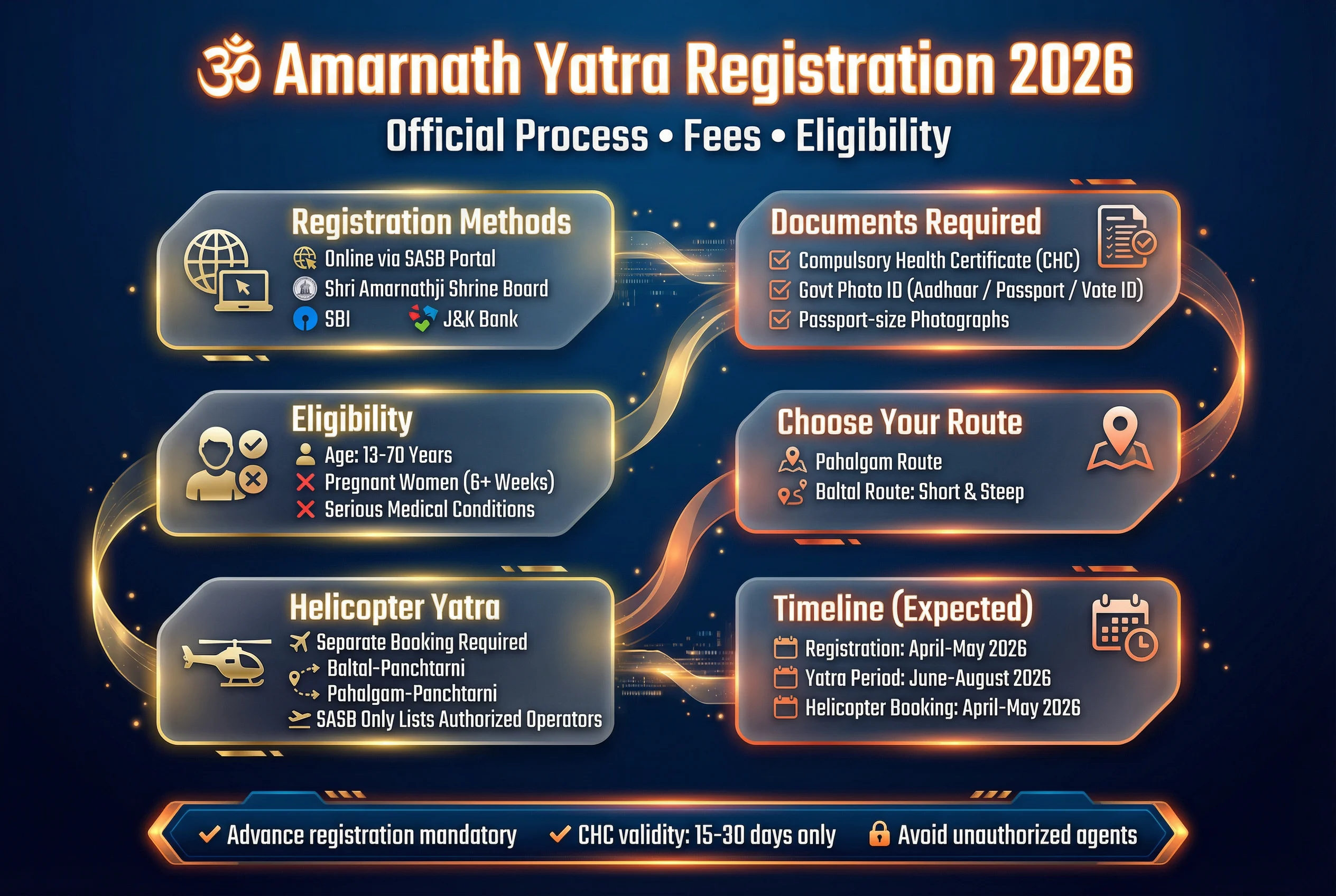
Advance registration for the annual Amarnath Yatra 2026 will begin on April 15 at more than 550 authorized bank branches nationwide.

Every year, millions of devoted pilgrims travel to the sacred Amarnath Cave to seek the blessings of Lord Shiva. The cave sits high up in the mountains of Jammu & Kashmir, and because of its great height, every pilgrim must complete a proper registration before starting the journey. At Shrine Yatra, we help pilgrims plan this holy trip smoothly and safely.

In this guide, we cover everything you need to know about Amarnath Yatra Registration 2026 – the full process, fees, documents, eligibility, and helicopter booking. Read every section carefully so you don’t miss any important step!

Amarnath Yatra Registration

Amarnath Yatra Registration 2026

The Shri Amarnathji Shrine Board (SASB) manages the entire registration process. Every pilgrim must register before starting the Yatra. You cannot enter the cave without a valid registration permit. SASB keeps this rule in place to protect the safety of all pilgrims and to manage the crowd efficiently.

Shrine Yatra strongly recommends that all pilgrims complete their registration well in advance to secure their preferred travel date and route.

Official Amarnath Yatra Registration Process (Step-by-Step)

SASB offers two ways to register for the Yatra. You can either register online from the comfort of your home or visit a bank branch for offline registration. Both methods are simple and easy to follow.

Online Registration Process

  • Open the official SASB website on your phone or computer. Look for the “Amarnath Yatra Registration 2026” link and click on it once SASB activates it.
  • Choose whether you want to register as an Individual or as a Group.
  • Read all the guidelines and eligibility rules that appear on the screen.
  • Fill in your personal details on the form – your full name, date of birth, gender, mobile number, email ID, and home address. Type everything exactly as it appears on your government ID.
  • Upload your ID proof, your Compulsory Health Certificate (CHC), and a recent passport-size photo.
  • Select your preferred Yatra Route – either the Pahalgam Route or the Baltal Route – along with your travel date.
  • Pay the registration fees using UPI, a Debit Card, or Net Banking.
  • After the payment goes through, your Yatra Registration Confirmation Slip will appear on the screen. Download it right away and print several copies to carry with you.

Offline Registration Process (Bank Branch)

  • Walk into an authorised bank branch. SASB usually allows registration at Punjab National Bank (PNB), State Bank of India (SBI), and J&K Bank branches.
  • Ask for the registration form at the counter. Fill it in carefully with your personal details – name, phone number, email address, and home address – exactly as they appear on your ID.
  • Attach a photocopy of your valid ID (such as your Aadhaar Card), the original and a copy of your CHC, and your passport-size photographs.
  • Select your route (Pahalgam or Baltal) and travel date on the form.
  • Hand over the form to the bank staff and pay the registration fees in cash or through another mode the bank accepts.
  • After your registration completes successfully, collect your Yatra Permit for 2026 and your registration receipt. Keep both documents safe.

SASB gives every pilgrim a colour-coded permit card. The colour depends on the day of travel and the route selected. Here is the full colour chart:

Day Pahalgam Route Baltal Route
Monday Lavender Lemon Chiffon
Tuesday Pink Lace Blue
Wednesday Beige Honeydew
Thursday Peach Lavender
Friday Lemon Chiffon Pink Lace
Saturday Blue Beige
Sunday Honeydew Peach

Documents Required for Amarnath Yatra Registration

Gather all your documents before you start the registration. Missing even one document can delay the process. Here is what you need:

Compulsory Health Certificate (CHC)

This certificate proves that you are medically fit to travel to such a high altitude. Only SASB-authorised hospitals or doctors can issue a valid CHC. Certificates from private clinics or personal doctors are not accepted.

Valid Identity Proof

Carry any one of these government-approved ID documents:

  • Aadhaar Card
  • Passport
  • Voter ID
  • Driving License
  • PAN Card

Recent Passport-Size Photographs

Most pilgrims need to submit 2 to 4 recent coloured passport-size photographs. Take the photos against a light or white background and make sure your face is clearly visible.

Eligibility Criteria for Amarnath Yatra Registration

SASB has set clear rules about who can register for this pilgrimage. The high altitude and thin air at the Amarnath Cave make it physically demanding. Read the criteria below and make sure you meet all the requirements before you apply.

Age Limit

Only pilgrims between 13 and 70 years of age can register for the Yatra. Children below 13 and elders above 70 are not allowed.

Medical Fitness

Every pilgrim must be in good physical health. You must visit an authorised hospital, get a medical checkup, and collect your CHC before registering.

Pregnancy Restriction

Women who are more than 6 weeks pregnant cannot register for this Yatra. SASB puts this rule in place to protect the health and safety of both the mother and the baby.

Who Is NOT Eligible?

The following pilgrims cannot register for the Amarnath Yatra:

  • People who are younger than 13 years or older than 70 years
  • Pilgrims with serious health conditions, including chronic heart disease, severe asthma or lung disorders, uncontrolled diabetes, high blood pressure, a history of major surgery, severe arthritis, or similar conditions
  • Pregnant women who are more than 6 weeks pregnant
  • Pilgrims whose registration form details do not match their ID documents
  • Those who do not have a valid CHC

Amarnath Yatra Registration 2026 – Key Dates and Timeline

Planning the trip ahead of time is very important. Use this timeline to stay prepared:

Event Expected Timeline
Registration Start Date 15 April 2026
Registration Deadline May 2026
Amarnath Yatra Opening Date Friday 3rd July 2026
Main Yatra Period June – August 2026
Yatra Closing Date (Shravan End) Friday, 28th August 2026
Last Reporting Date for Pilgrims 2–3 days before closing
Daily Slot Allotments Begin As soon as registration opens
Medical Certificate Validity Window 15–30 days before the Yatra start (Exact window will be announced with official notification)
Helicopter Booking Opens April–May 2026

Shrine Yatra advises pilgrims to register as soon as slots open because preferred dates and routes fill up quickly.

Amarnath Yatra Registration Fees

SASB charges a small and affordable fee for registration. This money goes toward the administrative and management work that SASB carries out for pilgrim safety and comfort.

Here is the complete fee structure:

Category Registration Fee (per person)
Indian Pilgrims (Online) ₹220
Indian Pilgrims (Offline) ₹150
NRI / Ex-India Pilgrims Around ₹1550

Payment Modes

Online Payment:

  • Debit Card
  • Credit Card
  • Net Banking
  • UPI Payments

Offline Payment:

  • Cash Payment
  • Bank Slip or Challan
  • Debit Card (check availability at your bank)

Always collect your payment receipt and save it in a safe place. You may need it later.

Registration for NRI

NRIs who wish to attend the Amarnath Yatra follow the same registration process as Indian residents. However, NRIs must keep a few extra points in mind:

  • NRIs must hold Indian citizenship and carry a valid Indian passport.
  • They must get their CHC from an authorised hospital inside India only. Medical certificates issued outside India are not accepted.
  • They can register online only after obtaining a valid CHC from India.
  • They must be physically present in India when registering at a bank branch. No one can register on their behalf, and postal registration is not allowed.
  • NRIs must also stay in India to complete their medical tests and collect their RFID card.
  • The registration fee for NRIs is higher than the fee for Indian residents.

Medical Certificate (CHC) – Format, Validity, and Hospitals List

The Compulsory Health Certificate (CHC) is one of the most important documents for Amarnath Yatra Registration. Without it, SASB will reject your application. The CHC confirms that you are physically fit and healthy enough to travel to the high-altitude cave.

Why Is CHC Compulsory?

The Amarnath Cave sits at a height of 12,700 feet above sea level. The air up there is thin, the temperature drops very low, and oxygen levels are reduced. Pilgrims with hidden or serious health problems can face life-threatening situations at such heights. The CHC protects pilgrims by checking their health before the journey begins.

Your registration will be rejected if you don’t have a valid CHC.

What Does the Certificate Contain?

The CHC follows the SASB-prescribed format and includes:

  • Pilgrim’s full name as per ID proof
  • Age and gender
  • Home address
  • An attested passport-size photograph of the pilgrim
  • Results of the medical examination, including blood pressure (BP), oxygen saturation (SpO2), pulse rate, and a general physical assessment
  • A declaration confirming the pilgrim’s fitness for the Amarnath Yatra
  • The doctor’s signature and seal
  • The hospital stamp
  • Date of the medical examination

CHC Validity Period

A CHC is valid only for a short window before the Yatra date. SASB typically accepts CHCs issued 15 to 30 days before the Yatra start date. Do not get your certificate too early or too late, as both will be considered invalid.

SASB announces the exact validity window along with the official registration notification each year.

Who Issues the CHC?

Only SASB-authorised hospitals or medical institutions can issue a valid CHC. Certificates from private clinics or family doctors do not meet the requirement.

Where to Find the Official Hospitals List?

Visit the official SASB website to find the state-wise list of authorised hospitals. SASB publishes this list along with the registration notification. Check the list every year because it changes from time to time.

Amarnath Yatra Routes Available During Registration

When you register, you must choose one of the two available routes to the Amarnath Cave. Each route suits different types of pilgrims. Study the comparison below and pick the route that matches your fitness level and travel preferences.

Aspect Pahalgam Route (Traditional Route) Baltal Route (Short and Steep Route)
Starting Point Pahalgam (Anantnag district) Baltal (near Sonamarg, Ganderbal district)
Total Distance (One Way) About 36–46 km About 14 km
Duration 3–5 days 1–2 days
Difficulty Level Moderate Difficult
Recommended For ·         Senior citizens

·         First-time pilgrims

·         Spiritually inclined Yatris

·         Physically fit pilgrims with trekking experience
Key Halts ·         Pahalgam

·         Chandanwari

·         Pissu Top

·         Sheshnag

·         Panchtarni

·         Holy Amarnath Cave

·         Baltal

·         Domel

·         Sangam

·         Holy Amarnath Cave

Acclimatization Better acclimatisation due to gradual ascent Limited acclimatization
Scenic Beauty Very scenic meadows and lakes Less scenic
Trek Nature Gradual ascent Very steep ascent and descent
Darshan Speed Slower but comfortable Faster Darshan but physically demanding

Shrine Yatra recommends the Pahalgam Route for elderly pilgrims and those who undertake the Yatra for the first time. Choose the Baltal Route only if you are very fit and have experience with steep trekking.

Helicopter Yatra Registration – Is It Separate?

Yes, helicopter registration is separate from Amarnath Yatra registration. Simply registering alone doesn’t imply helicopter booking. It needs to be done separately.

How to Book Helicopters?

To book the helicopter service, you must have completed Amarnath Yatra registration. This makes you eligible for the helicopter booking for the Yatra.

After you complete your Yatra registration, you can book a helicopter through authorised private aviation companies. SASB publishes the official links to these booking portals on its website. Always book through those authorised portals only.

Please keep in mind that SASB does not manage helicopter bookings.

Helicopter Yatra Routes

Helicopters operate on two routes for the Amarnath Yatra:

  • Baltal to Panchtarni
  • Pahalgam to Panchtarni

From Panchtarni, the holy cave sits about 6 km away. You can either walk the remaining distance or hire a pony or Palki service to reach the cave.

Documents Required for Helicopter Boarding

Carry all four of these documents when you arrive at the helipad:

  • Valid Amarnath Yatra permit
  • RFID card
  • Government-issued ID
  • Helicopter booking confirmation

Common Mistakes to Avoid during Registration

Many pilgrims make small errors during registration that cause big problems later. Shrine Yatra has put together a list of the most common mistakes so you can avoid them:

  • Do not submit an invalid CHC. Always get your certificate from an SASB-authorised hospital only.
  • Do not register if you don’t meet the eligibility criteria. SASB will cancel your registration.
  • Make sure your name, address, and other personal details match exactly across your CHC, ID proof, and registration form.
  • Do not choose the wrong route. Pick the Baltal route only if you are fit and have trekking experience. First-timers and senior citizens should always choose the Pahalgam route.
  • Do not wait until the last minute to register. Popular travel dates fill up fast, and latecomers often miss their preferred slots.
  • Do not forget to collect your RFID card. You need it to enter the Yatra zone.
  • Do not register through unauthorised agents or third-party websites. Always use the official SASB portal or authorised bank branches.

Summary

Amarnath Yatra Registration 2026 is a mandatory procedure and must be done by every pilgrim going for this Yatra. It can be done either online or offline. Devotees also have to satisfy a strict eligibility criteria. Pilgrims also have to obtain a CHC which deems them fit for this high-altitude journey. If you want to book a helicopter, then it must be done separately.

At Shrine Yatra, we help pilgrims like you complete this spiritual journey with ease and peace of mind. Contact us today for expert guidance, assistance with your registration, and the best Amarnath Yatra packages!

FAQs About Amarnath Yatra Registration 2026

Q1. Is Aadhaar mandatory for Amarnath registration?
No, any valid government-issued photo ID will do for registration. This could be your Voter ID, PAN Card, Passport, or Driving License.

Q2. Can senior citizens register?
Senior citizens above 70 years of age cannot register as they do not meet the eligibility criteria. Elderly devotees between the ages of 60 and 70 years can register, though.

Q3. Is on-the-spot registration allowed?
No, on-the-spot registration is not allowed. The Shri Amarnathji Shrine Board (SASB) has made the advance registration mandatory. This is done mainly to ensure pilgrim safety and to have better crowd management.

Q4. Can I change my route after registration?
No, the route change is strictly not allowed after registration. Once you register, your selected route and Yatra date are final!

Q5. Is medical fitness compulsory?
Yes, medical fitness is compulsory, since this is a very high-altitude journey. The pilgrims must obtain a CHC which certifies their fitness for this pilgrimage.

Shrine Yatra wishes every devotee a safe, blessed, and memorable Amarnath Yatra 2026.

Required Permits and How to Obtain Them for Adi Kailash

Adi Kailash Yatra Packages

Are you planning a trip to the holy Adi Kailash? This beautiful mountain sits in the Pithoragarh district of Uttarakhand. Many pilgrims and adventure lovers visit this place every year. But before you pack your bags, you need to know one very important thing, you must carry the right permits!

At Shrine Yatra, we help thousands of yatris every year. We know that getting permits can feel confusing. That is why we wrote this simple guide for you. Read it carefully, and your Adi Kailash journey will go smoothly!

What Is Adi Kailash and Why Is It Special?

Adi Kailash is also known as Chhota Kailash. People believe it looks just like the famous Mount Kailash in Tibet. Lord Shiva is said to live here. The peak stands at about 6,191 meters above sea level.

The route to Adi Kailash passes through the Inner Line — a border zone near China. Because of this, the Indian government requires all visitors to carry special permits. Without these permits, officials will not allow you to enter the area.

Shrine Yatra always tells its pilgrims: “Get your permits first, then start your yatra!”

Why Do You Need Permits for Adi Kailash?

The Adi Kailash region sits very close to the India-China border. The Indian Army keeps a close watch on this area. The government wants to make sure only registered visitors enter this sensitive zone.

Here is why permits matter:

  • National Security: The border area needs strict monitoring at all times.
  • Tourist Safety: Permits help rescue teams locate you if something goes wrong.
  • Environmental Protection: Controlled entry keeps the Himalayas clean and safe.
  • Legal Requirement: Traveling without permits can get you stopped or fined by the authorities.

Shrine Yatra always processes permits for its group members before the journey begins.

Required Permits and How to Obtain Them for Adi Kailash

Now let us talk about the most important part – the Required Permits and How to Obtain Them for Adi Kailash. There are mainly two types of permits you need.

1. Inner Line Permit (ILP) for Adi Kailash

The Inner Line Permit (ILP) is the most important document you need for the Adi Kailash Yatra. The government issues this permit to control entry into protected border zones.

Who Needs an Inner Line Permit?

Every Indian citizen who wants to visit the Adi Kailash region must carry an Inner Line Permit. Foreign nationals need special permission from the Ministry of Home Affairs and also require a Protected Area Permit (PAP).

Documents Required for ILP

Gather these documents before you apply:

  • A filled application form
  • Passport-size photographs (2 to 3 copies)
  • Aadhaar Card (photocopy)
  • Voter ID or any government-issued photo ID
  • Details of your travel route
  • Contact information and home address

How to Obtain the Inner Line Permit for Adi Kailash

You can get the ILP through two easy ways:

A) Online Method

The Uttarakhand government runs an official online portal where you can apply. Follow these steps:

  • Visit the official Uttarakhand Tourism or District Magistrate website.
  • Click on the “Inner Line Permit” section.
  • Fill in your personal details, travel dates, and route information.
  • Upload scanned copies of your documents.
  • Submit your application and pay the small processing fee.
  • Download and print your permit once the authorities approve it.

B) Offline Method

You can also visit the local government office in person. Here are the offices that issue ILPs:

  • District Magistrate (DM) Office, Pithoragarh: The main office for ILP issuance.
  • Sub-Divisional Magistrate (SDM) Office, Dharchula: Closer to the yatra starting point.
  • District Tourist Information Center, Pithoragarh

Visit the office, fill the form, submit your documents, and collect your permit on the same day or within 24 hours.

Inner Line Permit Fee

The ILP fee is very affordable. It usually costs between ₹100 to ₹600 depending on the duration of your stay. Shrine Yatra includes ILP processing in all its Adi Kailash tour packages, so you do not worry about this step.

Validity of Inner Line Permit

The ILP stays valid for the specific dates you mention in your application. If your travel dates change, you must apply for a revised permit. Always carry the original printed copy throughout your journey.

2. Protected Area Permit (PAP) for Foreign Nationals

If you hold a foreign passport, you need a Protected Area Permit (PAP) in addition to the regular entry requirements. The Ministry of Home Affairs of India issues this permit.

How Foreign Nationals Can Obtain the PAP

  • Apply through the Ministry of Home Affairs (MHA) online portal.
  • Contact the Indian Embassy in your home country for guidance.
  • Foreign nationals must travel in a group of at least two people.
  • A registered Indian tour operator like Shrine Yatra must sponsor your application.

Processing can take 4 to 8 weeks, so apply well in advance.

3. Kumaon Mandal Vikas Nigam (KMVN) Registration

The Uttarakhand government runs the Adi Kailash Yatra officially through KMVN — Kumaon Mandal Vikas Nigam. Registering with KMVN gives you access to managed accommodation, transport, and food facilities along the route.

How to Register with KMVN

  • Visit the KMVN official website and look for the Adi Kailash Yatra registration link.
  • Fill in your personal details, number of travelers, and travel dates.
  • Pay the registration charges online.
  • KMVN confirms your booking and sends you a confirmation receipt.

Shrine Yatra handles KMVN registration for all its pilgrims as part of our complete tour service.

4. Forest Department Permit

Some routes to Adi Kailash pass through protected forest zones. In such cases, the Uttarakhand Forest Department issues a separate forest entry permit.

How to Get the Forest Department Permit

  • Visit the Forest Range Officer’s office in Dharchula or Pithoragarh.
  • Show your ILP and identity proof.
  • Pay the nominal entry fee.
  • Carry the permit throughout the trek.

The fee is very small, and the office usually issues the permit on the spot.

Step-by-Step Process to Get All Permits for Adi Kailash

Shrine Yatra breaks down the entire permit process into simple steps:

Step 1: Plan Your Travel Dates

Fix your travel dates first. All permits are date-specific.

Step 2: Collect All Documents

Keep photocopies of your Aadhaar Card, passport-size photos, and voter ID ready.

Step 3: Apply for ILP Online or Offline

Visit the DM Office in Pithoragarh or apply through the official Uttarakhand government portal. Submit your documents and collect your permit.

Step 4: Register with KMVN

Visit the KMVN website and register your group for the Adi Kailash Yatra. Pay the registration fee and save your confirmation.

Step 5: Obtain the Forest Permit if Required

Check with your tour operator whether your route passes through forest zones. If yes, collect the forest permit from the local office.

Step 6: Carry All Permit Copies

Print multiple copies of each permit. Keep one set in your bag and another set with a trusted travel companion.

Step 7: Show Permits at Checkpoints

The Indian Army and local police set up checkpoints along the route. Show your permits confidently at each checkpoint.

Where Are the Permit Checkpoints on the Adi Kailash Route?

Officials check your permits at several points during the journey. Here are the main checkpoints:

  • Dharchula: The first major checkpoint where officials verify your ILP before you proceed further.
  • Tawaghat: Another checking point where authorities cross-verify your documents.
  • Gunji Village: A key military checkpoint in the Inner Line Zone.
  • Kalapani: Close to the sacred site; authorities do a final check here.

Always keep your permits handy at these locations. Never keep them inside a locked suitcase.

Tips from Shrine Yatra to Get Permits Without Stress

Our team at Shrine Yatra has helped hundreds of pilgrims get their permits quickly. Here are our top tips:

  • Apply Early: Start the permit process at least 15 to 20 days before your travel date. Do not wait till the last moment.
  • Keep Multiple Copies: Make at least three photocopies of every permit. Mountains are unpredictable, and papers can get wet or torn.
  • Use Registered Tour Operators: Registered companies like Shrine Yatra know exactly which permits you need. We take care of the paperwork so you can focus on your spiritual journey.
  • Verify Permit Details: Check your name, travel dates, and route details carefully before you leave home. Even a small spelling mistake can cause delays at checkpoints.
  • Carry Original ID Proofs: Do not rely only on digital copies. Carry original Aadhaar Card and voter ID at all times.
  • Stay Updated on Rules: The government sometimes changes permit rules during the season. Check the latest updates from the KMVN website or ask Shrine Yatra for the most recent information.

Best Time to Visit Adi Kailash and Permit Availability

The Adi Kailash Yatra runs from May to October every year. Heavy snowfall closes the route during the winter months.

The government opens permit applications usually from April onwards. Slots fill up fast during peak season (June, July, and August). Shrine Yatra recommends that you book your permits and tour package before April to avoid disappointment.

Can Shrine Yatra Arrange Permits for You?

Yes! Shrine Yatra offers a complete permit assistance service for all Adi Kailash pilgrims. When you book a tour package with us, our experienced team:

  • Applies for your Inner Line Permit on your behalf
  • Handles KMVN registration
  • Arranges Forest Department permits if required
  • Guides foreign nationals through the PAP application process
  • Updates you at every step of the permit process

You just need to send us your documents, and we handle the rest. Our goal is to make your Adi Kailash Yatra as smooth and peaceful as possible.

Frequently Asked Questions About Adi Kailash Permits

Q1. Can I visit Adi Kailash without a permit?
No. You cannot enter the Inner Line Zone without a valid ILP. Officials at checkpoints will turn you back.

Q2. How long does it take to get the Inner Line Permit?
Offline applications usually take one to two days. Online applications take three to five working days.

Q3. Can I apply for a permit on the spot in Pithoragarh?
Yes, the DM Office in Pithoragarh accepts walk-in applications. However, applying in advance is always safer.

Q4. Do children need a separate permit?
Yes. Every traveler, including children, needs their own Inner Line Permit.

Q5. What happens if I lose my permit during the journey?
Contact the nearest government office or KMVN station immediately. Always carry a photocopy as a backup.

Q6. Does Shrine Yatra process permits for solo travelers?
Yes! We help solo pilgrims, small groups, and large groups with permit processing. Contact our team for details.

Final Words from Shrine Yatra

The Required Permits and How to Obtain Them for Adi Kailash is something every pilgrim must understand before starting this sacred journey. The permit process is simple when you know the right steps. Our team at Shrine Yatra works every day to make your spiritual journey to Adi Kailash trouble-free and unforgettable.

Adi Kailash is a place of divine energy, breathtaking beauty, and deep faith. Do not let paperwork worries stop you from experiencing this wonder. Plan early, get your permits in order, and trust Shrine Yatra to guide you every step of the way.

Book your Adi Kailash Yatra with Shrine Yatra today and let us take care of everything – from permits to prayers!

Shrine Yatra – Where Every Journey Becomes a Pilgrimage.

What Are the Essential Items for a Kailash Mansarovar Yatra Packing List?

Kailash Mansarovar Yatra Packages

Every year, thousands of devoted pilgrims travel to one of the most sacred places on Earth, Mount Kailash and Lake Mansarovar. This journey tests your body, mind, and spirit like no other trip. At Shrine Yatra, we help pilgrims prepare smartly so they can focus on their spiritual experience rather than worrying about missing items.

Packing the right things makes a huge difference on this holy journey. The weather changes fast, the altitude climbs high, and the trails can be tough. That is why a proper Kailash Mansarovar Yatra packing list becomes your best friend before you leave home.

In this blog, we share every essential item you need to carry on this divine trip. We keep it simple, clear, and easy to understand so every pilgrim, young or old, can get ready with full confidence.

Why Does a Proper Packing List Matter for Kailash Mansarovar Yatra?

Mount Kailash sits at an altitude of about 6,638 meters above sea level. Lake Mansarovar rests at around 4,590 meters. These heights bring cold winds, thin air, and unpredictable weather every single day.

When you carry the right gear, you stay warm, safe, and energetic throughout the yatra. When you forget important items, you risk altitude sickness, frostbite, or extreme discomfort. Shrine Yatra always tells pilgrims that smart packing equals a safe journey.

Now, let us walk through every important category of items you must pack before starting this sacred adventure.

Kailash Mansarovar Yatra Packing List, Category by Category

1. Clothing and Layering Essentials

The temperature near Mount Kailash drops well below freezing, especially at night. You need to dress in layers so your body stays warm no matter what the weather throws at you.

Pack these clothing items:

  • Thermal inner wear (top and bottom): Wear thermal layers right against your skin. They trap body heat and keep you warm even in icy winds. Carry at least 3 sets.
  • Fleece jacket or sweater: A thick fleece jacket works as your middle layer. It adds extra warmth without feeling too heavy.
  • Waterproof and windproof outer jacket: Your outer shell must block wind and rain completely. Choose a jacket with a good hood for extra protection.
  • Trekking pants: Pack 2 to 3 pairs of comfortable, quick-dry trekking pants. Avoid jeans as they take too long to dry and feel stiff in cold weather.
  • Waterproof trekking shoes: Your shoes must have strong ankle support and a good grip on rocky trails. Break them in before the trip so your feet stay blister-free.
  • Warm socks: Carry at least 5 to 6 pairs of woolen or thermal socks. Wet or cold feet make trekking very painful.
  • Gaiters: Gaiters protect your legs and shoes from snow, mud, and water during the trek around Kailash.
  • Gloves: Pack one light pair and one heavy insulated pair of gloves. You will need both depending on the weather.
  • Woolen cap and balaclava: Cover your head, ears, and neck completely. A balaclava covers your face too, which helps during snowstorms.
  • Neck gaiter or scarf: Protect your throat and neck from cold air and wind.
  • Sunglasses with UV protection: The sunlight reflects off snow and ice, which can damage your eyes. Always wear high-quality UV-protected sunglasses.
  • Sun hat or cap: Protect your face from direct sunlight during daytime walking.
  • Rain poncho or rain cover: Always keep a compact rain poncho in your daypack for sudden showers.
  • Light cotton clothes: Pack a few light clothes for warmer stops like Kathmandu or Lhasa where the weather stays mild.

2. Backpacks and Bags

Choosing the right bag keeps your journey smooth and your back pain-free.

  • Main trekking backpack (50 to 70 liters): This large backpack carries most of your gear during the trek. Pick one with a padded back panel and hip belt.
  • Daypack (20 to 30 liters): You carry this smaller bag during daily walks. It holds your water bottle, snacks, documents, and quick-access items.
  • Waterproof bag covers: Always use waterproof covers on both bags to protect your belongings from rain and snow.
  • Dry bags or ziplock pouches: Store your documents, phone, and electronics inside waterproof dry bags to keep them safe from moisture.

3. Trekking Gear and Equipment

Good trekking gear gives you the support and stability you need on tough mountain trails.

  • Trekking poles: Use a pair of strong, adjustable trekking poles. They reduce pressure on your knees going uphill and downhill, and help you balance on slippery paths.
  • Crampons or microspikes: Attach these to your shoes on icy surfaces for better grip and safety. They prevent dangerous slipping on frozen trails.
  • Sleeping bag (rated for -20°C or lower): Even if your camp provides blankets, a personal sleeping bag keeps you warm through freezing nights. Do not compromise on this item.
  • Sleeping bag liner: A liner adds extra warmth inside your sleeping bag and also keeps it clean throughout the trip.
  • Trekking headlamp with extra batteries: You need a reliable headlamp for early morning starts and nighttime walks around the camp. Always carry spare batteries.
  • Portable solar charger: Electricity is scarce on this route. A small solar panel charger keeps your phone and other devices powered.

4. Health, First Aid, and Medicine Kit

Your health comes first on any high-altitude pilgrimage. Altitude sickness can affect anyone, so you must carry medicines and a first aid kit at all times.

Your first aid kit must include:

  • Diamox (Acetazolamide): Doctors widely recommend this medicine for preventing altitude sickness. Consult your doctor before the trip and carry this as prescribed.
  • Pain relievers: Carry paracetamol or ibuprofen for headaches, body aches, and fever.
  • Antacids and digestive tablets: Food and water in Tibet can sometimes upset your stomach. Antacids help you recover quickly.
  • Anti-diarrhea medicine: Carry this as a safety measure in case of stomach infections.
  • Cough and cold medicine: Cold air triggers coughing and throat infections easily at high altitude.
  • Antiseptic cream and bandages: Clean and cover small cuts or blisters quickly to prevent infections.
  • Moleskin or blister pads: Apply these directly on blisters to reduce pain while trekking.
  • Rehydration sachets (ORS): Replace lost salts and fluids quickly if you sweat heavily or feel dehydrated.
  • Pulse oximeter: This small device checks your blood oxygen level. A reading below 90% at high altitude needs immediate attention.
  • Thermometer: Monitor your body temperature easily with a compact digital thermometer.
  • Sunscreen (SPF 50+): The high-altitude sun burns your skin much faster than at sea level. Apply sunscreen generously every 2 hours.
  • Lip balm with SPF: Protect your lips from cracking in cold, dry air.
  • Eye drops: Dust, wind, and dryness irritate your eyes on mountain trails.
  • Personal prescription medicines: Always carry enough of your regular medicines for the full trip plus a few extra days.

5. Food and Nutrition Supplies

Your body burns extra calories fighting cold temperatures and trekking through high altitude. Keep your energy levels high with smart food choices.

  • High-energy snacks: Pack nuts, dry fruits, energy bars, chocolate, and roasted chana. These snacks boost your energy quickly between meals.
  • Instant oats or porridge packets: Easy to prepare and filling, these work great for quick breakfasts at camp.
  • Electrolyte powder: Mix this in your water to replace minerals lost through sweating and exertion.
  • Herbal tea bags: Ginger and tulsi tea warm you from inside and soothe altitude-related discomfort.
  • Glucose powder: Mix glucose in warm water for an instant energy boost during tough stretches.
  • Peanut butter or nut butter pouches: High in protein and healthy fats, these compact pouches give you lasting energy throughout the day.

6. Hydration and Water Purification

Staying hydrated at high altitude is critically important. Your body needs more water than usual because the air is dry and thin.

  • Insulated water bottle (1 liter): An insulated bottle keeps water from freezing in sub-zero temperatures. Carry at least two bottles.
  • Water purification tablets: Not all water sources on the route are clean. Drop a purification tablet in collected water before drinking it.
  • Portable water filter (like LifeStraw): A personal water filter removes bacteria and parasites from stream or lake water instantly.
  • Thermos flask: Fill this with hot water or tea in the morning. It keeps your drink warm for hours during cold treks.

7. Documents and Important Papers

Never overlook your paperwork. Missing or damaged documents can stop your entire journey.

  • Passport with minimum 6 months validity: Keep your passport valid well beyond your travel dates.
  • Indian Inner Line Permit (ILP): The Government of India issues this permit for Kailash Mansarovar Yatra. Apply through the Ministry of External Affairs (MEA) or through Shrine Yatra’s assisted process.
  • Tibet Travel Permit: Chinese authorities require this permit for entry into Tibet. Your tour operator arranges this for you.
  • Chinese Group Visa: Individual visas to Tibet are not available. Your tour operator applies for a group visa on behalf of all pilgrims.
  • Travel insurance documents: Always carry insurance that covers high-altitude trekking, medical emergencies, and helicopter evacuation.
  • Emergency contact list: Write down the names and phone numbers of family members, your tour operator, and local emergency services.
  • Passport-size photographs (10 to 12 copies): You need extra photos for permits, visas, and entry checkpoints along the route.
  • Photocopies of all documents: Store copies separately from originals in case you lose anything.

8. Personal Hygiene and Toiletries

Basic hygiene keeps you healthy and comfortable throughout the yatra.

  • Biodegradable soap and shampoo: Use eco-friendly products that do not harm the sacred water bodies and environment.
  • Toothbrush and toothpaste: Pack a compact travel toothbrush with a small tube of toothpaste.
  • Wet wipes and hand sanitizer: Bathing facilities are very limited on the route. Use wet wipes to clean your body and sanitize your hands before eating.
  • Quick-dry travel towel: A microfiber towel dries fast and takes very little space in your backpack.
  • Toilet paper and tissue packs: Always carry extra tissue and toilet rolls, especially for outdoor toilet breaks on the trek.
  • Trowel (for digging cat holes): If no toilet facility is available, dig a small hole at least 200 meters away from any water source.
  • Menstrual hygiene products: Female pilgrims should carry adequate menstrual supplies as availability along the route is very limited.
  • Nail cutter and small scissors: Keep your nails trimmed to prevent dirt buildup and discomfort inside thick socks and gloves.
  • Compact mirror: Useful for grooming and for signaling in emergency situations.

9. Electronics and Gadgets

Technology helps you stay safe, connected, and capture memories on this once-in-a-lifetime pilgrimage.

  • Smartphone with offline maps: Download offline maps of the route before you leave. Mobile data is unavailable in most parts of Tibet.
  • Camera with extra memory cards and batteries: Capture the divine beauty of Lake Mansarovar and Mount Kailash. Cold weather drains batteries faster, so always carry extras.
  • Power bank (high capacity): A 20,000 mAh power bank keeps your devices charged for multiple days without electricity.
  • Universal travel adapter: Charge your devices at hotels in Kathmandu, Lhasa, and other stops with different socket types.
  • Satellite communicator or emergency beacon: In areas with zero mobile coverage, a satellite device helps you send SOS signals and messages to family or rescue teams.

10. Spiritual and Religious Items

This journey is deeply spiritual. Carry items that support your religious practices and devotion throughout the yatra.

  • Rudraksha mala or prayer beads: Use your mala for chanting mantras and prayers during the parikrama around Mount Kailash.
  • Small idol or photograph of your deity: Keep your beloved deity close to your heart throughout the sacred journey.
  • Religious books or scriptures: Carry a compact copy of the Shiva Chalisa, Hanuman Chalisa, or any text meaningful to your faith.
  • Camphor and agarbatti (incense sticks): Perform simple prayers and rituals at sacred spots along the route.
  • Gangajal (holy Ganga water): Many pilgrims carry a small bottle of Gangajal to offer at Lake Mansarovar and other holy sites.
  • Flowers and offerings: Some pilgrims carry dried flower petals or small offering materials for rituals.
  • Journal or diary: Write down your experiences, thoughts, and prayers each day. This spiritual diary becomes a lifelong treasure.

11. Miscellaneous but Must-Have Items

These small items often make the biggest difference during the yatra.

  • Duct tape: Fix torn shoes, broken equipment, or leaking bags quickly with strong duct tape.
  • Safety pins and sewing kit: Repair torn clothing easily while on the trail.
  • Whistle: Use a loud whistle to signal for help in emergencies.
  • Lighter or waterproof matches: Useful for lighting candles, camphor, or emergency fires.
  • Pocket knife or multi-tool: A compact multi-tool handles many small tasks on the trail.
  • Garbage bags: Always carry your waste back. Keep the sacred land clean and respect the environment.
  • Trekking map of the Kailash parikrama route: Study the route map carefully before starting the parikrama to understand distances and checkpoints.
  • Cash in small denominations (Chinese Yuan and Indian Rupees): ATMs are rare or unavailable on the route. Carry adequate cash for meals, tips, and emergencies.
  • Portable lock: Secure your backpack zippers and lockers at guesthouses with small padlocks.
  • Stuff sacks and packing cubes: Organize your bag neatly so you find items quickly without unpacking everything.

Things You Must NOT Pack for Kailash Mansarovar Yatra

Shrine Yatra also wants you to know what you should leave behind. Carrying unnecessary items adds weight and slows you down.

Avoid packing:

  • Heavy books or magazines — download everything on your phone or tablet instead
  • Too many clothes — you will repeat outfits, and that is completely fine
  • Expensive jewelry — keep your valuables at home or in a hotel safe
  • Aerosol cans — they can explode at high altitude due to pressure changes
  • Single-use plastics — protect the sacred environment by going zero waste
  • Alcohol and non-vegetarian food products — most yatra routes discourage these items out of respect for the religious nature of the journey

How Shrine Yatra Helps You Prepare Better

At Shrine Yatra, we go beyond just booking your tickets and permits. We walk with you through every step of the preparation process. Our experienced team provides:

  • A personalized pre-departure packing checklist based on your specific route and travel dates
  • Expert advice on altitude acclimatization and fitness preparation
  • Guidance on obtaining all necessary permits and visas without hassle
  • Round-the-clock support throughout your journey
  • Emergency assistance and evacuation coordination if needed

We have helped thousands of pilgrims complete the Kailash Mansarovar Yatra safely and successfully. Our team knows this route deeply, and we share that knowledge freely with every traveler who trusts us.

Frequently Asked Questions (FAQs)

Q1. How heavy should my backpack be for Kailash Mansarovar Yatra?

Your main backpack should not exceed 10 to 12 kg. On the actual parikrama, try to keep your daypack under 5 kg. Yaks or porters carry heavier loads, but you must manage your daypack yourself.

Q2. Can I rent trekking gear at the base camp?

Some basic items are available on rent at Darchen (the base camp for parikrama), but availability and quality are not always reliable. Shrine Yatra recommends you carry your own essential gear for safety and comfort.

Q3. What type of shoes works best for this yatra?

Waterproof, insulated trekking boots with ankle support work best. Make sure you wear them for at least 2 to 3 weeks before the trip to break them in properly.

Q4. Is it safe to drink tap water along the route?

No. Always purify water using tablets or a filter before drinking. Carry your own water purification supplies at all times.

Q5. How many days of clothing should I pack?

Pack clothes for 7 to 10 days and plan to rewear them. Focus on quick-dry and odor-resistant fabrics to stay fresh without excessive washing.

Q6. Does Shrine Yatra provide sleeping bags and trekking poles?

Shrine Yatra helps you arrange or rent quality gear based on your needs. Contact our team before your trip to discuss your specific requirements.

Final Words from Shrine Yatra

The Kailash Mansarovar Yatra stands as one of the most powerful and spiritually transforming pilgrimages in the world. Every step you take around the sacred Mount Kailash fills your heart with devotion, gratitude, and inner peace.

But this journey demands serious preparation. When you pack the right items, you protect your health, respect the environment, and fully open yourself to the divine experience this holy land offers.

Use this complete Kailash Mansarovar Yatra packing list as your guide, check off each item carefully, and step onto this sacred path with full confidence and a joyful heart.

Shrine Yatra stands with you, every step of the way.

Contact us today to start planning your Kailash Mansarovar Yatra. Our team is ready to guide, support, and walk alongside you on this once-in-a-lifetime spiritual journey.

चार धाम यात्रा 2026: 50 काउंटर से रजिस्ट्रेशन, AI से ट्रैफिक मैनेजमेंट, जानें पूरी तैयारी

Char Dham Yatra 2026

उत्तराखंड सरकार ने चार धाम यात्रा 2026 की तैयारियों को पूरी ताकत के साथ शुरू कर दिया है। प्रशासन ने यात्रियों की सुविधा के लिए 50 ऑफलाइन रजिस्ट्रेशन काउंटर खोलने का फैसला किया है। देहरादून डीएम सविन बंसल ने सभी विभागों को जरूरी निर्देश दे दिए हैं।

इस बार बिना रजिस्ट्रेशन के कोई भी यात्री चार धाम यात्रा नहीं कर सकेगा। सरकार ने ऑनलाइन रजिस्ट्रेशन की सुविधा तो दी ही है, साथ ही ऑफलाइन रजिस्ट्रेशन के लिए भी पूरी व्यवस्था तैयार की है। प्रशासन ने ऑफलाइन रजिस्ट्रेशन के लिए कुल 50 काउंटर बनाने का निर्णय लिया है। इनमें ऋषिकेश में 30 काउंटर और विकासनगर में 20 काउंटर स्थापित किए जाएंगे। ये सभी काउंटर दिन-रात यानी पूरे 24 घंटे काम करेंगे, ताकि किसी भी यात्री को परेशानी न हो।

देहरादून में हुई समीक्षा

चार धाम यात्रा 2026 को सफल बनाने के लिए देहरादून डीएम सविन बंसल ने गुरुवार को एक बड़ी समीक्षा बैठक बुलाई। ऋषिपर्णा सभागार में यह बैठक हुई, जिसमें चार धाम यात्रा से जुड़े सभी विभागों के अधिकारी मौजूद रहे। बैठक में ऋषिकेश और विकासनगर इलाके में वाहनों की पार्किंग, यात्रियों के ठहरने की जगह, रजिस्ट्रेशन व्यवस्था, सड़क, पेयजल, परिवहन, भोजन, शौचालय और सफाई जैसी सभी जरूरी सुविधाओं पर गहराई से चर्चा हुई।

डीएम ने ट्रैफिक इंतजामों को और बेहतर बनाने पर खास जोर दिया। उन्होंने डायवर्जन प्लान और रोशनी की व्यवस्था को पहले से ज्यादा मजबूत करने के निर्देश दिए। बैठक में सभी जरूरी इंतजामों को समय पर पूरा करने के आदेश दिए गए। डीएम ने यात्रा व्यवस्थाओं की निगरानी के लिए नोडल और सेक्टर अधिकारियों की तैनाती के निर्देश दिए। पुलिस विभाग को पर्याप्त संख्या में पुलिस बल, होमगार्ड, पीआरडी और वॉलंटियर तैनात करने को कहा गया।

चार धाम यात्रा को लेकर निर्देश

  • चार धाम यात्रा मार्ग में ऑफलाइन रजिस्ट्रेशन के लिए ऋषिकेश में 30 और विकासनगर में 20 काउंटरों की व्यवस्था की जाएगी।
  • रजिस्ट्रेशन स्थलों पर श्रद्धालुओं के ठहरने के लिए पर्याप्त इंतजाम किए जाएंगे।
  • डीएम सविन बंसल ने चार धाम यात्रा को लेकर सभी विभागों के साथ बैठक में जरूरी निर्देश दिए हैं।
  • चार धाम यात्रा के ऑफलाइन रजिस्ट्रेशन काउंटर पर 24 घंटे अधिकारी मौजूद रहेंगे।
  • चार धाम यात्रा में आने वाले श्रद्धालुओं के लिए पर्याप्त मेडिकल सुविधाओं का इंतजाम किया जाएगा।
  • यात्रा के दौरान बाहरी राज्यों से आने वाले वाहनों पर प्रशासन की पैनी नजर रहेगी।
  • चार धाम यात्रा मार्ग पर ट्रैफिक की व्यवस्था में एआई टेक्नोलॉजी का प्रयोग किया जा सकता है।

रजिस्ट्रेशन काउंटर होंगे व्यवस्थित

चार धाम यात्रा पर आने वाले हर श्रद्धालु को अच्छी सुविधा मिले, इसके लिए प्रशासन ने सभी तैयारियां समय से पहले पूरी करने का लक्ष्य रखा है। डीएम ने रजिस्ट्रेशन काउंटरों पर प्रशिक्षित ऑपरेटर, पर्याप्त स्टाफ, तेज इंटरनेट और 24 घंटे सेवा सुनिश्चित करने के आदेश दिए हैं। इसके अलावा रजिस्ट्रेशन स्थल पर मोबाइल पंजीकरण टीमें भी तैनात की जाएंगी।

डीएम ने बताया कि ऑफलाइन रजिस्ट्रेशन काउंटरों पर यात्रियों की कतार लगाने की सुविधा बनाई जाएगी। धूप और बारिश से बचाने के लिए वहां शेड बनाए जाएंगे। रजिस्ट्रेशन स्थल पर यात्रियों के बैठने की उचित व्यवस्था की जाएगी। उन्होंने यह भी बताया कि यात्रियों के आवागमन के लिए होल्डिंग एरिया तक शटल सेवा भी चलाई जाएगी।

15 अप्रैल तक पूरी होगी तैयारी

डीएम ने सभी विभागों को 15 अप्रैल तक यात्रा की सभी व्यवस्थाएं पूरी करने का सख्त निर्देश दिया है। उन्होंने बताया कि चार धाम यात्रा मार्ग पर एंबुलेंस के साथ-साथ विशेषज्ञ डॉक्टरों की भी तैनाती की जाएगी। डीएम सविन बंसल ने साफ कहा कि चार धाम यात्रा की व्यवस्थाओं में बजट की कोई कमी नहीं आने दी जाएगी। जिस भी विभाग को अतिरिक्त पैसों की जरूरत हो, वह फौरन प्रस्ताव भेजे।

जरूरी नंबर होंगे सार्वजनिक

चार धाम यात्रा के दौरान अगर किसी यात्री को कोई परेशानी होती है, तो वह कंट्रोल रूम में अपनी शिकायत दर्ज करा सकेगा। प्रशासन ने कंट्रोल रूम और हेल्पलाइन नंबरों को सार्वजनिक करने का आदेश जारी किया है। डीएम ने निर्देश दिया है कि होल्डिंग एरिया, पार्किंग स्थल, प्रमुख चौक-चौराहों और यात्रा मार्गों पर होटल, धर्मशाला और आश्रमों के फोन नंबर, हेल्पलाइन और कंट्रोल रूम के संपर्क नंबर चिपकाए जाएंगे। एलईडी स्क्रीन के जरिए यात्रा के दौरान जरूरी जानकारियां लगातार दिखाई जाएंगी।

डीएम ने अधिकारियों को निर्देश दिया कि चार धाम यात्रा के दौरान नाइट स्टे के लिए निर्धारित समय तक होटल और पार्किंग स्थलों का अधिग्रहण पूरा कर लिया जाए। परिवहन विभाग को पर्याप्त वाहनों का अधिग्रहण करने, वाहनों की फिटनेस जांच कर ग्रीन कार्ड जारी करने और ट्रिप कार्ड जेनरेशन की वैकल्पिक व्यवस्था तैयार करने को कहा गया।

बाहरी वाहनों पर होगी सख्ती

चार धाम यात्रा 2026 में बाहरी राज्यों से रजिस्ट्रेशन कराकर आने वाले व्यावसायिक वाहनों पर इस बार सख्त नजर रखी जाएगी। आरटीओ ने बताया कि अन्य राज्यों से एनओसी लेकर एआरटीओ कार्यालयों में रजिस्ट्रेशन और पता बदलवाने के लिए रोज आवेदन आते हैं। कुछ आवेदनकर्ता किराया अनुबंध या किसी अन्य पते का प्रमाण देते हैं। अब आवेदनकर्ता के मूल पते और अस्थायी पते की जांच और पुष्टि के बाद ही आवेदन को स्वीकार किया जाएगा।

स्पेशलिस्ट डॉक्टर होंगे तैनात

चार धाम यात्रा 2026 के दौरान यात्रा मार्ग पर राज्य सरकार के डॉक्टरों के साथ-साथ केंद्रीय संस्थानों के विशेषज्ञ डॉक्टर भी तैनात रहेंगे। राज्य सरकार के अनुरोध पर केंद्रीय स्वास्थ्य मंत्री जेपी नड्डा ने इसकी पूरी सहमति दी है। उत्तराखंड के स्वास्थ्य मंत्री डॉ. धन सिंह रावत ने गुरुवार को नई दिल्ली में केंद्रीय स्वास्थ्य मंत्री जेपी नड्डा से मुलाकात की और उन्हें चार धाम यात्रा की सभी जरूरी जानकारियां दीं।

स्वास्थ्य मंत्री ने केंद्रीय मंत्री से अनुरोध किया कि एम्स और देश के अन्य बड़े केंद्रीय संस्थानों के माहिर डॉक्टरों को भी चारधाम में तैनात किया जाए, ताकि आम तीर्थयात्रियों को बेहतर इलाज मिल सके। मंत्री ने यह भी बताया कि केदारनाथ और बदरीनाथ धाम में आधुनिक अस्पताल तैयार हो चुके हैं और इस यात्रा सीजन में इनका उद्घाटन किया जाएगा।

एआई से ट्रैफिक मैनेजमेंट

उत्तराखंड के राज्यपाल लेफ्टिनेंट जनरल गुरमीत सिंह (रिटायर्ड) ने चार धाम यात्रा की तैयारियों को लेकर डीजीपी दीपम सेठ के साथ विशेष बैठक की। राज्यपाल ने पुलिस को निर्देश दिया कि चारधाम यात्रा और कुंभ आयोजन के प्रबंधन में एआई तकनीक का भरपूर उपयोग किया जाए।

गुरुवार को डीजीपी दीपक सेठ ने लोक भवन पहुंचकर राज्यपाल से मुलाकात की और चारधाम तथा कुंभ की तैयारियों की पूरी जानकारी दी। राज्यपाल ने कहा कि कुंभ जैसे दुनिया के बड़े आयोजन में एआई और नई तकनीकों का व्यापक उपयोग होना चाहिए। इससे भीड़ को संभालना, संदिग्ध गतिविधियों को पकड़ना और रियल-टाइम निगरानी रखना बहुत आसान और प्रभावी हो जाएगा।

संपर्क करें

जिला सूचना कार्यालय, देहरादून, उत्तराखंड, हेल्पलाइन नंबर जल्द सार्वजनिक किए जाएंगे।

If you are planning for Char Dham, book here https://www.shrineyatra.in/char-dham-packages

How to Book a Guided Adi Kailash Yatra Trek Online

Adi Kailash Yatra Packages

Every year, thousands of devotees and adventure lovers plan a trip to Adi Kailash, one of the most sacred and beautiful destinations in the Himalayas. If you also dream of visiting this divine place, Shrine Yatra makes it easy for you. You can now book your guided Adi Kailash Yatra trek online from the comfort of your home. In this blog, we will walk you through each step in a simple and easy way so that even a 10-year-old can understand how to plan and book this holy trek.

What is Adi Kailash Yatra?

Adi Kailash is a stunning mountain peak located in the Pithoragarh district of Uttarakhand, India. People also call it Chota Kailash because it looks just like the famous Mount Kailash in Tibet. Many Hindus believe that Lord Shiva himself lives on this peak. The Adi Kailash Yatra takes you through green forests, crystal-clear rivers, high mountain passes, and ancient temples. It is a journey that fills your heart with peace, devotion, and excitement at the same time.

Why Choose Shrine Yatra for Your Adi Kailash Yatra Trek?

Shrine Yatra is one of the most trusted travel companies for religious treks in India. We take care of everything so you can focus only on your spiritual journey. Here is why so many pilgrims and trekkers choose us:

  • We provide expert local guides who know every path of the Adi Kailash trek.
  • We offer comfortable stays, healthy meals, and safe transportation throughout the yatra.
  • We handle all government permits and paperwork needed for the trek.
  • We design our tour packages keeping families, senior citizens, and first-time trekkers in mind.
  • Our online booking process is fast, simple, and secure.

Step-by-Step Guide to Book Adi Kailash Yatra Trek Online

Booking your Adi Kailash Yatra trek online with Shrine Yatra takes just a few minutes. Follow these simple steps below:

Step 1: Visit the Shrine Yatra Official Website

Open your phone, tablet, or computer and go to the official Shrine Yatra website. You will find a clean and easy-to-use homepage. Look for the search bar or the menu at the top of the page. Type “Adi Kailash Yatra” in the search bar or click on the Yatra or Treks section in the main menu. The website will show you all available packages for the Adi Kailash Yatra trek.

Step 2: Choose the Right Adi Kailash Tour Package

Shrine Yatra offers multiple Adi Kailash tour packages to match different budgets, group sizes, and travel dates. When you pick a package, check for the following things:

  • Number of days included in the trek
  • Starting and ending point of the journey
  • Type of accommodation (camps or guesthouses)
  • Meals included in the package
  • Price per person
  • Things to do and places to visit along the route

Take your time and compare two or three packages before you decide. Each package page clearly lists everything that is included and excluded so you face no surprises later.

Step 3: Check the Adi Kailash Yatra Trek Dates and Availability

The Adi Kailash Yatra trek runs during a specific season, usually from May to October. Once you select a package, check the calendar on the website to see which dates are available. Shrine Yatra updates its schedule regularly. You can pick a date that works best for your school holidays, family schedule, or personal plans. If you spot a date that suits you, act quickly because popular dates fill up fast.

Step 4: Fill in the Booking Form

Click the “Book Now” button on your chosen package page. A booking form will appear on the screen. Fill in all the required details carefully. You will need to provide:

  • Your full name
  • Your mobile number and email address
  • Number of people joining the trek
  • Preferred travel date
  • Any special requests or health conditions

Make sure you double-check every detail before you move to the next step. Correct information helps our team prepare the best experience for your group.

Step 5: Upload Required Documents for Adi Kailash Yatra Permit

The Adi Kailash Yatra falls in a restricted area near the India-China border. So, every trekker needs a special Inner Line Permit to visit this region. Shrine Yatra takes care of the permit process for you. You just need to upload a few documents on the website during booking. These usually include:

  • A valid government photo ID (Aadhar card, voter ID, or passport)
  • A recent passport-size photograph
  • A filled-in consent form (provided by Shrine Yatra)

Our team will review your documents and apply for the Adi Kailash Yatra permit on your behalf. This saves you a lot of time and confusion.

Step 6: Make the Online Payment

After filling in your details and uploading your documents, you will reach the payment page. Shrine Yatra offers multiple safe payment options including credit cards, debit cards, UPI, net banking, and popular wallets. You can also pay a small advance amount to confirm your booking and pay the rest before the trek begins. All transactions go through a secure payment gateway, so your money stays completely safe.

Step 7: Receive Your Booking Confirmation

Once you complete the payment, Shrine Yatra will send a booking confirmation directly to your email and mobile number. This confirmation includes your trip details, itinerary, meeting point, and contact information for your trek guide. Save this confirmation message carefully. You will need it on the day of your departure.

What to Expect on the Adi Kailash Yatra Trek

The Adi Kailash Yatra trek covers some of the most breathtaking landscapes in the entire Himalayan range. As you travel from Dharchula to Gunji and then towards the base camp of Adi Kailash, you will see snow-covered peaks, ancient temples, small Himalayan villages, and the stunning Om Parvat mountain — a peak that naturally shows the sacred symbol “Om” in snow. The entire experience fills trekkers with a deep sense of awe and devotion. Our expert guides share interesting stories about the mythology and history of each place you visit along the way.

Adi Kailash Yatra Trek Route and Highlights

The standard Adi Kailash Yatra route starts from Kathgodam or Dharchula, depending on the package you choose. Here are the major highlights of the trek:

  • Dharchula – The gateway town where your adventure truly begins
  • Tawaghat – A small village surrounded by tall mountains and dense trees
  • Narayan Ashram – A peaceful spiritual retreat deep in the forest
  • Gunji – The last major village before entering the restricted zone
  • Kalapani – A historical and sacred site near the Kali River
  • Adi Kailash Base Camp – Where you see the divine peak in all its glory
  • Om Parvat – The magical mountain with natural Om symbol in snow
  • Parvati Sarovar – A holy lake near the base of Adi Kailash

Important Tips Before You Book Adi Kailash Yatra Online

Before you hit the “Book Now” button, keep these helpful tips in mind:

  • Book your trek at least 30 to 45 days in advance because seats fill up quickly during peak season.
  • Check the weather forecast for the trekking dates to prepare the right clothing and gear.
  • Talk to your doctor if you have any health issues because the trek goes through high-altitude areas.
  • Read the full itinerary carefully so you know what is included in your package.
  • Contact the Shrine Yatra helpline if you have any questions before or after booking.

Adi Kailash Yatra Packing List

Shrine Yatra sends every traveler a detailed packing list after booking confirmation. But here is a quick idea of what you should carry on your Adi Kailash Yatra trek:

  • Warm woolen clothes and a waterproof jacket
  • Comfortable trekking shoes with a good grip
  • A small backpack for daily essentials
  • Sunscreen, sunglasses, and a hat for sun protection
  • A personal first aid kit with basic medicines
  • A water bottle and energy snacks
  • A valid photo ID (required at checkpoints)

Adi Kailash Yatra Cost and Budget

The Adi Kailash Yatra cost varies depending on the number of days, type of accommodation, and group size. Shrine Yatra offers packages to fit different budgets, starting from affordable shared group tours to premium private tours with luxury camping. All our packages include guide fees, permit charges, meals, and transportation within the trek route. We believe every devotee deserves a chance to experience this sacred yatra without worrying about hidden costs.

Frequently Asked Questions About Adi Kailash Yatra Trek Online Booking

Is it safe to book Adi Kailash Yatra online?

Yes, it is completely safe to book your Adi Kailash Yatra trek online through Shrine Yatra. We use a secure payment system and protect all your personal information. Thousands of happy pilgrims have already booked their yatra with us online without any issues.

Can children join the Adi Kailash Yatra trek?

Yes, children above the age of 10 can join the Adi Kailash Yatra with a parent or guardian. We recommend that younger children consult a doctor before the trek because of the high altitude. Our guides always keep a close eye on younger members of the group throughout the journey.

What is the best time to do the Adi Kailash Yatra?

The best time to go on the Adi Kailash Yatra trek is between May and June and then again in September and October. The weather stays pleasant, the roads remain open, and the mountain views look absolutely stunning during these months. Shrine Yatra runs regular departures during this entire season.

Can I cancel my booking if my plans change?

Yes, Shrine Yatra offers a flexible cancellation policy. If you need to cancel or reschedule your Adi Kailash Yatra booking, contact our team as early as possible. The refund amount depends on how many days before the trek you cancel. Full details appear on our website under the cancellation policy section.

Why Adi Kailash Yatra is a Once-in-a-Lifetime Experience

Not many places in the world offer the combination of spiritual energy, natural beauty, and adventure that the Adi Kailash Yatra provides. Standing at the base of this magnificent peak, gazing at the Om symbol on Om Parvat, and taking a holy dip in Parvati Sarovar — these are moments that stay with you forever. Whether you go as a devotee seeking blessings or as an explorer seeking adventure, this trek gives you something truly special in return. Shrine Yatra makes sure every trekker returns home with beautiful memories, a peaceful mind, and a heart full of gratitude.

Conclusion

Booking your guided Adi Kailash Yatra trek online with Shrine Yatra is simple, fast, and completely safe. Just visit our website, pick the right package, fill in your details, upload your documents, and complete the payment. Our experienced team handles everything else so that you can enjoy a smooth and stress-free journey to one of the most sacred places in the Himalayas. Do not wait too long — the mountains are calling, and Shrine Yatra is ready to take you there. Book your Adi Kailash Yatra today and begin the adventure of a lifetime!

Contact Shrine Yatra today and book your Adi Kailash Yatra trek online now!

Amarnath Yatra 2026 – Everything You Need to Know Before You Go

Amarnath Yatra 2026

Every year, thousands of devoted pilgrims walk through the snow-covered mountains of Kashmir to reach one of the most sacred shrines in India – the Amarnath Cave. The Amarnath Yatra 2026 gives devotees a wonderful chance to seek the blessings of Lord Shiva and witness the miracle of a naturally formed ice Shivalinga. This holy journey takes place high up in the Himalayan mountains at an altitude of about 12,756 feet. Whether you are a first-time visitor or a returning pilgrim, this guide covers everything you need to know about the Amarnath Yatra 2026 — from important dates and registration to routes, packing tips, and safety rules.

What is Amarnath Yatra?

The Amarnath Yatra is a deeply spiritual pilgrimage that millions of Hindus undertake every year. Pilgrims travel to the Amarnath Cave, located in the Kashmir Himalayas, to see a naturally forming ice Shivalinga — an image of Lord Shiva made entirely of ice. This ice Shivalinga grows and shrinks with the phases of the moon, which makes it truly magical and divine.

Devotees believe that visiting this holy cave washes away all sins and brings great peace and blessings into their lives. The cave also holds a special place in Hindu mythology, as it is believed that Lord Shiva revealed the secret of immortality to Goddess Parvati at this very spot.

Amarnath Yatra 2026 Dates

The Amarnath Yatra 2026 is scheduled to begin on July 1, 2026, and conclude on August 28, 2026, coinciding with the auspicious festival of Raksha Bandhan. The Yatra begins on the auspicious day of Skanda Shashti as per the Hindu calendar and concludes on Shravan Purnima, which falls on Raksha Bandhan. The entire Yatra lasts approximately 45 to 47 days, giving pilgrims enough time to plan and complete their journey comfortably.

Here is a quick look at the important dates:

  • Yatra Start Date: July 1, 2026
  • Yatra End Date: August 28, 2026
  • Registration Start: April 14, 2026
  • Total Duration: Approx. 45–47 days

Amarnath Yatra 2026 Registration

Registration is the most important step before starting the Amarnath Yatra. Registration is mandatory and operates on a first-come, first-served basis. Without a valid registration permit, no pilgrim can enter the Yatra route. So pilgrims must complete their registration well in advance to secure their preferred travel date.

Who Can Register?

  • Persons with age below 13 years and above 70 years are not allowed
  • Pregnant women with more than 6 weeks of pregnancy are not allowed
  • All other healthy individuals between 13 and 70 years of age can apply for registration

Online Registration Process

Pilgrims can register from the comfort of their home by following these simple steps:

  • Visit the official website of the Shri Amarnathji Shrine Board (SASB) at jksasb.nic.in
  • Click on “Yatra Permit Registration” under Online Services
  • Read the guidelines carefully and agree to the terms
  • Fill in your full name, date of birth, gender, mobile number, email ID, and address
  • Upload your Compulsory Health Certificate (CHC), a valid photo ID, and a passport-size photograph
  • Select your preferred route — Pahalgam or Baltal — and choose your travel date
  • Pay the registration fee of approximately ₹220 using UPI, debit card, or net banking
  • Download your Yatra Registration Confirmation Slip

Offline Registration Process

For offline registration, you need to pay a fee of Rs.220 per person. You can make the offline registrations through Jammu & Kashmir Bank, Punjab National Bank, State Bank of India (SBI) and YES Bank at any of the branches across India.

Documents Required for Registration

Every pilgrim must carry these essential documents at the time of registration:

  • Compulsory Health Certificate (CHC) — issued by an SASB-authorized doctor or hospital
  • Valid Government Photo ID — Aadhaar card, passport, voter ID, or driving license
  • Passport-size Photographs — 2 to 4 recent photographs against a light background
  • Mobile Number — for OTP verification during online registration

Note: Read in the details about how to register for Amarnath?

What is a Compulsory Health Certificate (CHC)?

The Amarnath Cave sits at a very high altitude where the air is thin and the temperature drops very low. To make sure every pilgrim stays safe, the SASB makes it mandatory for all pilgrims to carry a Compulsory Health Certificate (CHC).

A CHC ensures a pilgrim is not suffering from a serious health condition which can be life-threatening at high altitudes. Your registration gets rejected if you don’t have a valid CHC.

The CHC can only be issued by SASB-authorised hospitals or medical institutions. One obtained from private clinics or family doctors is considered invalid. Pilgrims must visit the official SASB website to find the list of authorized hospitals in their state.

Daily Pilgrim Limit for Amarnath Yatra 2026

The Shri Amarnathji Shrine Board puts a limit on the number of pilgrims allowed each day to ensure safety and avoid overcrowding on the mountain trails. 7,500 pilgrims would be allowed to register for Shri Amarnath Yatra 2026 per day per route. This means the Pahalgam-Chandanwari Track and the Sonamarg-Baltal Track would each be allowed to have 7,500 registrations for pilgrims each day. This limit is separate from those who travel by helicopter.

Routes to Amarnath Cave

Two main routes lead devotees to the holy Amarnath Cave. Pilgrims can choose either route based on their fitness level and personal preference.

1. Pahalgam Route (Traditional Route)

The Pahalgam route is the longer and more traditional path to the Amarnath Cave. While longer, it offers a gentler and more scenic walk. Pilgrims pass through beautiful meadows, sparkling rivers, and snow-covered landscapes. This route passes through Chandanwari base camp, the stunning Sheshnag Lake, and the Panchtarni camp before reaching the cave. Most first-time pilgrims and senior citizens prefer this route.

2. Baltal Route (Shorter Route)

The Baltal route covers about 14 km and takes pilgrims directly to the cave in a shorter time. However, the path is steep and physically challenging. The trek is not just about religion — it’s an adventure filled with breathtaking landscapes, spiritual vibes, and a once-in-a-lifetime kind of experience. Young and physically fit pilgrims usually prefer the Baltal route.

Helicopter Services

Pilgrims who find trekking difficult can also book a helicopter service from both the Pahalgam and Baltal routes. The helicopter takes pilgrims to Panjtarni, which is close to the cave, saving time and physical effort. However, helicopter tickets must be booked separately through the official SASB portal or authorized operators.

RFID Card — Your Travel Identity

Every registered pilgrim receives an RFID (Radio Frequency Identification) Card at the start of the Yatra. Pilgrims must complete registration through the Shri Amarnathji Shrine Board portal and obtain an RFID Card, which serves both as ID and tracking device. This card helps authorities track each pilgrim’s location and respond quickly in case of any emergency.

What to Pack for Amarnath Yatra 2026

Packing the right things makes a huge difference on this high-altitude journey. Here is a simple packing checklist for pilgrims:

Clothing and Gear:

  • Thick woolen clothes and thermal inners
  • Waterproof rain jacket or poncho
  • Strong, comfortable trekking shoes with a good grip
  • Warm socks, gloves, and a woolen cap
  • Sunglasses to protect eyes from snow glare

Food and Health Supplies:

  • Light snacks like dry fruits, energy bars, and biscuits
  • A water bottle (drink at least 5 liters of fluids per day)
  • A basic first-aid kit with medicines for altitude sickness, fever, and pain
  • Walking stick or trekking pole for support

Important Documents:

  • Yatra registration permit
  • RFID card
  • Original government photo ID
  • Compulsory Health Certificate (CHC)

Food Rules During Amarnath Yatra 2026

The SASB has set strict food guidelines to keep pilgrims healthy during the Yatra. Pilgrims are encouraged to eat light, sattvik (pure vegetarian) meals that are easy to digest and suitable for high-altitude exertion. The Yatra routes have many free food stalls called Langars run by volunteers and religious organizations. These langars serve hot vegetarian meals to all pilgrims free of cost.

Non-vegetarian food, alcohol, and tobacco products are completely banned on the Yatra routes. Pilgrims must respect these rules to maintain the sanctity of the pilgrimage.

Health and Safety Tips for Amarnath Yatra 2026

The mountains of Kashmir are beautiful, but they also demand respect and careful preparation. Here are some important health and safety tips every pilgrim must follow:

Before the Yatra:

  • Start a preparatory morning/evening walk, about 4–5 km per day, at least a month prior to the Yatra
  • Practice deep breathing exercises and yoga, especially pranayama, to improve your body’s oxygen efficiency
  • Get a full medical check-up and obtain your CHC from an authorized doctor

During the Yatra:

  • Drink lots of water to combat dehydration and headaches — about 5 litres of fluid per day
  • Consume plenty of carbohydrates to reduce fatigue and maintain energy levels
  • Walk slowly and take regular rest breaks to let your body adjust to the high altitude
  • Never walk alone — always stay with your group
  • Descend immediately to a lower elevation if you start having altitude illness symptoms
  • In case of any signs of High Altitude Sickness or any other discomfort, immediately contact the nearest medical facility located at every 2 km

Things to Avoid:

  • Don’t drink alcohol, caffeinated drinks, or smoke
  • Do not use plastic bags — plastic use is strictly banned in the region and is punishable by law
  • Do not ignore warning signs from your body. Rest when needed
  • Do not register through unauthorized agents

How to Reach the Base Camps?

Most pilgrims start their Amarnath Yatra journey from Jammu, which is the main gateway city.

From Jammu to Pahalgam: Pilgrims travel by road from Jammu to Pahalgam, which takes approximately 5 to 6 hours. From Pahalgam, the trek to the cave begins.

From Jammu to Baltal (via Srinagar): Pilgrims travel from Jammu to Srinagar and then onwards to Sonamarg and Baltal by road. From Baltal, the shorter but steeper trek begins.

Trains and flights connect many major cities in India to Jammu. Pilgrims traveling from Delhi, Mumbai, or other big cities can book trains to Jammu Tawi railway station and then travel by road to the base camp.

Note: Read in the details about how to reach Amarnath Cave?

Types of Registration Available

The SASB offers three types of registration to serve pilgrims with different needs:

Individual Registration: This registration is meant for solo travelers or groups of fewer than 10 people. Each person must submit their own documents and health certificate.

Group Registration: Groups of 10 or more people can register together under group registration. This makes the process easier for large families and organized pilgrimage groups.

NRI Registration: Non-Resident Indians who plan to travel from abroad to attend the Amarnath Yatra can register under this special category with their valid foreign travel documents.

Spiritual Significance of Amarnath Yatra

The Amarnath Yatra holds a very special place in Hindu religion and culture. The legend of Amarnath recounts Lord Shiva revealing cosmic secrets in the cave. Pilgrims chant “Bam Bam Bhole” in devotion.

The ice Shivalinga inside the cave forms completely naturally without any human effort. It grows larger during the waxing phase of the moon and shrinks during the waning phase. The Holy Cave Shrine of Shri Amarnathji has the devout flock in the month of Shravan (July–August), where the image of Lord Shiva in the form of a Lingam is formed naturally of ice as a stalagmite, and which waxes and wanes with the moon.

Many pilgrims say that the moment they see the ice Shivalinga, they feel an overwhelming sense of peace and spiritual connection. The journey itself — through rivers, meadows, and mountains — feels like a moving prayer.

Important Tips for First-Time Pilgrims

If you plan to attend the Amarnath Yatra 2026 for the first time, keep these tips in mind:

  • Register early — slots fill up very fast, especially for popular dates in early July when the ice Shivalinga is at its largest
  • Choose the Pahalgam route if you are a senior citizen, first-timer, or someone who wants a gentle and scenic trek
  • Train your body at least one month before the Yatra by walking 4–5 km every day
  • Carry warm clothes even if the weather seems mild — mountain temperatures drop very sharply at night and during rain
  • Respect the rules set by the SASB regarding food, plastic use, and safety protocols
  • Book travel and accommodation early as hotels and transport fill up quickly during the Yatra season
  • Download the official SASB app to get real-time updates, weather alerts, and emergency contact information

Note: Do’s and Don’ts for Amarnath Yatra 2026: Complete Guide

Frequently Asked Questions (FAQs) About Amarnath Yatra 2026

Q: When does the Amarnath Yatra 2026 start and end?

A: The Amarnath Yatra 2026 starts on July 1, 2026, and ends on August 28, 2026.

Q: When does registration open for Amarnath Yatra 2026?

A: Registration opens on April 14, 2026, and closes based on slot availability.

Q: What is the age limit for Amarnath Yatra 2026?

A: Only pilgrims between 13 years and 70 years of age can participate.

Q: Can pregnant women attend the Amarnath Yatra?

A: No, pregnant women — especially those with more than 6 weeks of pregnancy — cannot attend the Yatra.

Q: How much does registration cost?

A: The registration fee is approximately ₹220 per person.

Q: How many pilgrims can register per day?

A: 7,500 pilgrims can register per day per route (Pahalgam and Baltal routes separately), excluding helicopter travelers.

Q: Is helicopter service available for Amarnath Yatra 2026?

A: Yes, helicopter services operate from both Pahalgam and Baltal routes to Panjtarni, near the cave.

Q: What is an RFID card?

A: The RFID card is a tracking card issued to every registered pilgrim. It helps authorities locate pilgrims and ensure their safety during the Yatra.

Q: Which route is better — Pahalgam or Baltal?

A: The Pahalgam route is longer but gentler and more scenic, suitable for first-timers and senior citizens. The Baltal route is shorter but steeper, better suited for physically fit individuals.

Q: Can I visit Amarnath Cave after July 20?

A: While the cave remains open until August 28, the ice Shivalinga is fully formed and at its best in early July. After July 20, the lingam begins to melt and may not be fully visible.

Conclusion

The Amarnath Yatra 2026 stands as one of the most magnificent and spiritually fulfilling journeys a person can take in their lifetime. From the snow-draped peaks of Kashmir to the divine glow of the ice Shivalinga inside the sacred cave, every step of this pilgrimage fills the heart with devotion and wonder. The SASB works hard every year to make this journey safe, organized, and accessible for lakhs of pilgrims from across India and the world.

If you plan to join the Amarnath Yatra 2026, start your preparations today. Get your health check-up done, gather your documents, and register early through the official SASB website before slots fill up. Walk with faith, follow all safety guidelines, take care of your health, and respect the sacred mountain environment. The blessings of Lord Shiva await every devoted pilgrim who takes this incredible journey with an open heart and pure soul.

Note: All dates mentioned above are tentative and subject to official confirmation by the Shri Amarnathji Shrine Board (SASB). Pilgrims must check the official SASB website at jksasb.nic.in for the latest and most accurate information before making any travel plans.

How to Reach Amarnath Cave with Route Map?

how to reach Amarnath

Reaching Amarnath Cave teaches you something important right away. The mountains test your body and your patience before they show you their beauty. Many people look at the map and think the journey looks simple. But the moment you start walking, the real adventure begins.

Two official routes take pilgrims to the holy cave. One starts from Pahalgam. The other starts from Baltal.

Both paths lead you to the same sacred cave, but they feel nothing alike. One route moves slowly and gives your body time to settle. The other finishes faster but pushes your strength hard. Pick your route based on how strong your body feels, not how quickly you want to finish.

Baltal Route – Short, Steep, and Physically Demanding

Baltal → Domali → Barari → Sangam → Holy Cave

This route covers about 14 km one way. That number sounds easy at first. But every step on this path quickly reminds you that short does not mean simple.

The slope stays steep almost the whole way. Your legs feel heavy early. Your breathing speeds up faster than you expect. Even strong walkers stop to rest many times along the way.

Distance breakup:

  • Baltal to Domali – around 2 km
  • Domali to Barari – around 6 km
  • Barari to Sangam – around 4 km
  • Sangam to Cave – around 2 km

Authorities do not allow pony rides on this route because the steep path makes it unsafe for animals. So every pilgrim either walks the full distance or takes a dandi (palanquin). This makes the journey much more demanding compared to the other route.

Most pilgrims finish the round trip in one or two days. But those days mean long hours of walking, very little rest, and seriously tired legs by the time evening comes.

People make a big mistake when they think this route feels easy. The cold wind, thin mountain air, and sharp slope work together and drain your energy much sooner than you plan.

This route suits:

  • Young pilgrims
  • Physically fit travelers
  • People used to trekking

It does not suit:

  • Senior citizens
  • Heart or breathing patients
  • Knee or back pain sufferers
  • First-time trekkers

Many experienced pilgrims use a smart plan. They walk up through Pahalgam and walk down through Baltal. Coming downhill on this steep slope feels far easier than climbing up it.

Pahalgam Route – Longer, Slower, and Easier on the Body

Pahalgam → Chandanwari → Sheshnag → Panchtarni → Cave

Pilgrims have walked this trail for generations. It stretches longer than the Baltal path, but it treats your body with far more kindness.

First, you ride 16 km by road from Pahalgam to Chandanwari. The trekking begins at Chandanwari.

  • Chandanwari to Sheshnag – about 13 km
  • Sheshnag to Panchtarni – about 4.6 km
  • Panchtarni to Cave – about 6 km

Most pilgrims walk between 36 and 48 km total and spread the journey over 3 to 5 days.

This route feels gentler mostly because of the steady, slow climb. But the support system along the path also helps a lot. Medical camps sit at regular spots. Food stalls keep you fueled. Resting points let you pause. Pony services carry those who need extra help. Wide walking tracks give everyone enough space to move comfortably.

The gradual climb gives your lungs and body time to get used to the high altitude. That adjustment lowers exhaustion and reduces the chance of altitude sickness.

Even with all this support, the journey still challenges you. Long hours of walking, sudden rain, freezing nights, and busy crowds remain part of every pilgrim’s experience on this path.

This route works well for:

  • First-time pilgrims
  • Senior citizens
  • Families
  • People who prefer steady pacing

For most pilgrims, this route offers the safer and more comfortable way to reach the cave.

How to Reach Amarnath – Practical Travel Reality

No transport drops you directly at the cave. Every pilgrim first travels to Jammu or Srinagar by their chosen mode. Then road travel takes them to Pahalgam or Baltal. After that, the trek or helicopter ride completes the journey.

Distance from Delhi: roughly 638 km

By Air – Most Comfortable Option

Srinagar Airport serves as the closest airport to the yatra base camps.

From Srinagar:

  • Pahalgam sits about 95 km away
  • Baltal sits about 71 km away

Flying saves a huge amount of time and keeps your body fresh before the trek starts. Elderly travelers and families benefit the most from choosing this option.

By Train – Budget Friendly, Time Heavy

Jammu Tawi Railway Station works as the nearest railhead.

After reaching Jammu, you continue the rest of the journey by road. Trains cost less, but the combined train and road journey eats up a lot of time and energy. By the time many people reach the base camp, they already feel tired before the trekking even starts.

By Road – Flexible but Exhausting

Buses and taxis run from Delhi and many other cities directly toward Jammu and Srinagar. Road travel can take anywhere from 12 to 30 hours depending on how far you start and what the roads feel like that day.

Long road journeys drain your body significantly. Many pilgrims arrive at the base camp already feeling worn out, which makes the trek ahead even harder.

Coming from Other Major Cities

  • Kolkata → Amarnath: around 1804 km
  • Mumbai → Amarnath: around 1714 km
  • Hyderabad → Amarnath: around 1896 km

Pilgrims traveling from these cities follow the smartest path when they combine options:

Flight or train → Srinagar or Jammu → road → base camp → trek

This approach saves your energy for the trek instead of spending it all on travel.

Things People Rarely Plan For (But Should)

  • Sudden rain or snowfall
  • Strong cold winds
  • Slippery tracks
  • Long waiting queues
  • Night discomfort at camps
  • Breathlessness due to altitude

Every single thing on this list happens regularly on the mountain. None of it surprises experienced pilgrims. Planning for these situations ahead of time makes the whole yatra smoother and safer.

Before you pack your bag, read our complete Do’s and Don’ts for Amarnath Yatra 2026: Complete Guide to make sure you stay safe and prepared on every step of the journey.

Who Should Pause and Reconsider

  • People with serious heart problems
  • Chronic respiratory illness
  • Severe joint issues
  • Recent surgery patients
  • Very young children

Every person in this group must visit a doctor and get a full medical check before deciding to go. The mountain demands a lot from your body, and knowing your limits protects you.

Simple Ground-Level Advice

  • Walk slowly
  • Drink water even if you do not feel thirsty
  • Rest when your body asks for it
  • Start early every morning
  • Avoid heavy food during trekking
  • Carry only the essentials in your bag

These six habits separate pilgrims who enjoy the journey from those who struggle through it.

Common Questions Pilgrims Actually Ask

1. Which route is better for first-time pilgrims – Baltal or Pahalgam?

Pahalgam works better for first-timers. The slope rises slowly, and your body gets enough time to adjust to the altitude without feeling overwhelmed.

2. How fit do I need to be for the yatra?

If you walk 6 to 8 km comfortably on flat ground, you can handle the yatra. Walking regularly in the weeks before you leave helps your body prepare.

3. Do people face breathing problems during the trek?

Yes, some pilgrims feel breathless, especially at the higher sections of the route. Walking slowly and resting often takes care of most breathing difficulties.

4. Is the Baltal route risky?

The route itself stays safe, but the steep and tiring climb makes it very hard. Only fit and experienced walkers should attempt this path.

5. Can senior citizens do this yatra?

Yes, senior citizens can complete the yatra through the Pahalgam route or by helicopter. Medical clearance from a doctor remains essential before they begin.

6. How many days should I keep for the full journey?

Set aside 4 to 7 days. That time covers travel to the base camp, the trek itself, the darshan, and the return journey comfortably.

7. Is weather a serious issue?

Weather changes fast on the mountain. Rain, cold winds, and sudden temperature drops happen without warning. Keep extra days free in your plan so weather delays do not ruin your schedule.

8. Are medical facilities available on the route?

Government medical camps operate at regular points along both routes. Trained staff stay ready to help pilgrims who feel unwell during the trek.

9. Is network connectivity available during the trek?

Mobile signals disappear quickly once you move beyond the base camps. Download offline maps and inform your family about your daily plan before you lose signal.

10. Should I choose helicopter or trekking?

Choose the helicopter if your health creates concerns or your time runs short. Choose trekking if your body feels strong and you want to experience the full spiritual journey.

Final Advice

Amarnath Yatra fills your heart with devotion, but it also demands real strength from your body. The mountains follow their own rules. They do not slow down or soften themselves for anyone. You have to adjust yourself to match them.

Move slowly, pay attention to what your body tells you, and pick the route that honestly matches your fitness level. When you do that, the journey stops feeling like a test and starts feeling like a true pilgrimage.

For most pilgrims, the gradual and steady Pahalgam route brings far more joy and safety than rushing through the steep and punishing Baltal path.

Check out: How to Register for Amarnath Yatra 2026

Chardham Yatra: पहली बार केदारनाथ व बदरीनाथ धाम में लगेगी एटीसी प्रणाली, पल-पल मिलेगी मौसम की जानकारी

Do Dham Yatra by Helicopter Tour Package

Chardham Yatra 2026: सरकार ने इस साल चारधाम यात्रा को पहले से ज्यादा सुरक्षित और आसान बनाने का फैसला किया है। केदारनाथ, बदरीनाथ, गंगोत्री और हेमकुंड साहिब जैसे पवित्र धाम ऊंचे पहाड़ों पर बसे हैं। इन जगहों पर मौसम बहुत तेजी से बदलता है। कभी धूप तो कभी बारिश और कभी घना कोहरा छा जाता है। ऐसे में हेलिकॉप्टर उड़ाना बहुत मुश्किल और खतरनाक हो जाता है।

ATC प्रणाली से मिलेगी हर पल की मौसम जानकारी

इस बार यूकाडा यानी उत्तराखंड नागरिक उड्डयन विकास प्राधिकरण ने एक बड़ा कदम उठाया है। पहली बार केदारनाथ और बदरीनाथ धाम में हवाई यातायात नियंत्रण यानी एटीसी प्रणाली लगाई जाएगी। यह सिस्टम हर मिनट मौसम की जानकारी देगा। इससे हेलिकॉप्टर पायलटों को पता चलेगा कि आसमान में उड़ना सुरक्षित है या नहीं। अगर मौसम खराब होगा तो हेलिकॉप्टरों को उड़ान की अनुमति नहीं दी जाएगी।

पिछले साल हुए हादसों के बाद उठाया बड़ा कदम

केदारनाथ और बदरीनाथ धाम उच्च हिमालयी क्षेत्र में होने से यहां पल-पल मौसम बदलता है। घाटियों में धुंध व बारिश हेलिकॉप्टरों की उड़ान में बाधा उत्पन्न करने के साथ हादसे का खतरा बना रहता है। पिछले साल केदारनाथ और उत्तरकाशी में दो हेलिकॉप्टर हादसे हुए। इन दुर्घटनाओं में 13 लोगों की जान चली गई। यह बहुत दुखद था। इसके बाद डीजीसीए और यूकाडा ने मिलकर हेलिकॉप्टरों की सुरक्षित उड़ान के लिए कई सख्त नियम बनाए।

सिरसी और सहस्त्रधारा में पहले ही लग चुकी है एटीएस प्रणाली

सरकार ने पहले ही सिरसी और सहस्त्रधारा हेलिपैड पर एटीएस प्रणाली लगा दी है। अब इस काम को आगे बढ़ाते हुए केदारनाथ और बदरीनाथ में भी यही काम होगा। यात्रा शुरू होने से पहले दोनों धामों में एटीसी प्रणाली काम करने लगेगी। इसके साथ ही हेलिकॉप्टरों पर लाइव ट्रैकिंग भी लगाई जाएगी। इससे अधिकारी हर हेलिकॉप्टर की उड़ान पर नजर रख सकेंगे।

25 फरवरी तक पूरी होगी टेंडर प्रक्रिया

उत्तराखंड नागरिक उड्डयन विकास प्राधिकरण के सीईओ आशीष चौहान ने बताया कि केदारनाथ हेली सेवा के लिए 25 फरवरी तक टेंडर प्रक्रिया पूरी कर ली जाएगी। इसके बाद केदारनाथ व बदरीनाथ धाम में एटीसी सिस्टम लगाने का काम शुरू होगा। उन्होंने कहा कि प्रदेश में सुरक्षित हेली सेवा के संचालन के लिए फुल प्रूफ व्यवस्था बनाने का प्रयास किया जा रहा है। सरकार चाहती है कि हर यात्री सुरक्षित तरीके से दर्शन कर घर लौटे।

Chardham Yatra 2026 में यह नई व्यवस्था लाखों श्रद्धालुओं की यात्रा को पहले से कहीं ज्यादा सुरक्षित बनाएगी। एटीसी प्रणाली और लाइव ट्रैकिंग से हेलिकॉप्टर सेवाएं बेहतर और भरोसेमंद होंगी।

If you are planning for Do Dham Yatra, book here: https://www.shrineyatra.in/do-dham-packages

चारधाम यात्रा 2026, इस बार ऑनलाइन रजिस्ट्रेशन के लिए देना होगा शुल्क

Chardham Yatra 2026 New Registration Fee Rule Guideline

जो लोग 2026 में चारधाम के पवित्र मंदिरों की यात्रा करना चाहते हैं, उन्हें पंजीकरण प्रणाली में आने वाले बड़े परिवर्तनों के बारे में जानना बहुत जरूरी है। उत्तराखंड सरकार ने ऑनलाइन पंजीकरण के लिए नए नियम घोषित किए हैं। ये नियम उन सभी लोगों को प्रभावित करेंगे जो इस पवित्र यात्रा पर जाना चाहते हैं।

पंजीकरण में क्या बदलाव आ रहे हैं?

अप्रैल 2026 से शुरू होकर, जो भक्त चारधाम यात्रा के लिए साइन अप करेंगे, उन्हें पंजीकरण शुल्क देना होगा। पहले लोग बिल्कुल मुफ्त में पंजीकरण करा सकते थे। अब सरकारी अधिकारियों ने एक समिति बनाई है जो तय करेगी कि भक्तों को कितना शुल्क देना होगा।

सरकारी अधिकारियों ने सुझाव दिया है कि लोग कम से कम 10 रुपये का पंजीकरण शुल्क दें। यह छोटी सी रकम नकली पंजीकरण को रोकने में मदद देगी। इससे यह सुनिश्चित होगा कि केवल सच्चे भक्त ही पंजीकरण करवाएं। सरकार समिति की सिफारिशों को मंजूरी देने के बाद ही अंतिम शुल्क की घोषणा करेगी।

Chardham 2026 Registration Fee Rules

Char Dham Yatra Registration Guide 2026: https://www.shrineyatra.in/char-dham-biometric-registration

सरकार इस शुल्क को क्यों लगा रही है?

उत्तराखंड सरकार ने यह शुल्क एक गंभीर समस्या को सुलझाने के लिए लगाया है। बहुत से लोग नकली पंजीकरण बनाते थे। ये लोग होटल और ट्रांसपोर्ट बुक करते थे, लेकिन वास्तव में मंदिरों की यात्रा करने का कोई इरादा नहीं रखते थे। इस गलत काम से सच्चे भक्तों को बहुत परेशानी होती थी जो वास्तव में मंदिरों जाना चाहते थे।

शुल्क देकर सरकार असली भक्तों को पहचान सकेगी जो सच में यात्रा करना चाहते हैं। प्रशासन नकली बुकिंग को खत्म कर सकेगा जो सिस्टम को गंदा करती है। इससे असली यात्रियों को होटल और ट्रांसपोर्ट में सीट मिलना आसान हो जाएगा।

2026 में मंदिरों के कपाट कब खुलेंगे?

अपना कैलेंडर निकाल लीजिए! चारों पवित्र मंदिर अप्रैल 2026 में अलग-अलग तारीखों पर अपने दरवाजे खोलेंगे।

19 अप्रैल 2026 को मंदिर के पुजारी पारंपरिक पूजा-पाठ करके यमुनोत्री और गंगोत्री मंदिरों के दरवाजे खोलेंगे। दो दिन के बाद, 22 अप्रैल 2026 को केदारनाथ मंदिर के दरवाजे भक्तों के लिए खुल जाएंगे। आखिर में, 23 अप्रैल 2026 को बद्रीनाथ मंदिर के कपाट खोले जाएंगे। इसके बाद पवित्र यात्रा पूरी हो जाएगी।

Char Dham Opening Dates https://www.shrineyatra.in/char-dham-opening-closing-dates

ये खुलने की तारीखें सैकड़ों साल पुरानी परंपरा को मानती हैं। पुजारी विशेष अनुष्ठान करते हैं और फिर भक्तों को मंदिरों में जाने देते हैं।

अधिकारी यात्रा के मौसम की तैयारी कैसे कर रहे हैं?

गढ़वाल के कमिश्नर और पुलिस के बड़े अधिकारियों ने हाल ही में होटल मालिकों, परिवहन कंपनियों और कुली संघों के साथ महत्वपूर्ण बैठकें की हैं। जो लोग भी यात्रा के व्यापार से जुड़े हैं, वे सब इकट्ठा हुए और आने वाले मौसम की तैयारियों के बारे में बातचीत की।

इन बैठकों में होटल के मालिकों ने अपनी चिंताएं साझा कीं। उन्होंने बताया कि वर्तमान नियमों के अनुसार होटलों को यह रिकॉर्ड रखना होता है कि कितने भक्त उनके होटल में ठहरते हैं। होटल मालिकों ने सरकार से कहा कि ये नियम बदल दें क्योंकि व्यस्त मौसम में ये बहुत परेशानी पैदा करते हैं।

बैठकों के बाद अधिकारियों ने क्या कदम उठाए?

कमिश्नर ने बैठकों में उठाई गई सभी समस्याओं को सुलझाने के लिए दो अलग-अलग समितियां बनाईं। एक समिति पंजीकरण शुल्क तय करेगी। दूसरी समिति टूर कंपनियों, परिवहन प्रदाताओं और कुली संघों की समस्याओं का समाधान करेगी।

ये समितियां जल्द से जल्द अपनी सिफारिशें सरकार को देंगी। जब सरकार के अधिकारी इन सिफारिशों को मंजूरी दे देंगे, तब यात्रा प्रशासन तुरंत ऑनलाइन पंजीकरण शुरू कर देगा। सभी को आशा है कि यह जल्दी होगा ताकि भक्त अपनी पवित्र यात्राओं के लिए पंजीकरण करवा सकें।

पंजीकरण प्रक्रिया को समझें

जो भक्त चारधाम मंदिरों की यात्रा करना चाहते हैं, उन्हें नई पंजीकरण प्रक्रिया को अच्छे से समझना चाहिए। ऑनलाइन पंजीकरण सिस्टम हर भक्त की जानकारी, उनके पसंदीदा मंदिर और यात्रा की तारीखें रिकॉर्ड करेगा। यह सिस्टम अधिकारियों को भक्तों के आने-जाने का प्रबंधन करने में मदद देगा। इससे मंदिरों को भी पता चल जाता है कि कितने भक्त आने वाले हैं।

जब आप पंजीकरण करवाते हैं, तो आप अपनी व्यक्तिगत जानकारी, फोन नंबर, आपातकालीन संपर्क और पसंदीदा मंदिरों के बारे में बताते हैं। पंजीकरण शुल्क देकर आप दिखाते हैं कि आप सच में यात्रा करना चाहते हैं। अधिकारी इस जानकारी का इस्तेमाल करके यह रोकते हैं कि कोई एक से ज्यादा बार नकली बुकिंग न करे।

2026 की यात्रा के लिए भक्त कैसे तैयारी कर सकते हैं?

अगर आप या आपका परिवार 2026 में चारधाम यात्रा करना चाहते हैं, तो अभी से तैयारी शुरू कर दें। सबसे पहले अपने दस्तावेज जैसे पहचान पत्र और स्वास्थ्य प्रमाणपत्र इकट्ठा कर लें। अपने सभी साथियों को बताएं कि पहाड़ों पर चढ़ना कितना कठिन होता है।

फिर सरकारी वेबसाइटों पर नजर रखें और पंजीकरण खुलने की खबर का इंतजार करें। जब पंजीकरण शुरू हो, तो जल्दी से अपना पंजीकरण करवा लें और शुल्क दे दें। जल्दी पंजीकरण करने से आप होटल और ट्रांसपोर्ट में अपनी पसंद के विकल्प चुन सकते हैं।

भक्तों को अपने खर्चे की सावधानी से योजना बनानी चाहिए। पंजीकरण शुल्क, ट्रांसपोर्ट खर्च, होटल, खाना और मंदिरों में दान को अपने बजट में शामिल करें। बहुत सारे भक्त संगठित समूहों के साथ जाना पसंद करते हैं क्योंकि ये समूह सारे काम और सुरक्षा का ध्यान रखते हैं।

इस नई पंजीकरण प्रणाली के क्या लाभ हैं?

नई पंजीकरण प्रणाली भक्तों और सेवा प्रदाताओं दोनों की सुरक्षा करती है। सच्चे भक्तों को अब होटल और ट्रांसपोर्ट में नकली बुकिंग के साथ प्रतिस्पर्धा नहीं करनी पड़ेगी। होटल मालिक आश्वस्त हो सकते हैं कि उनकी बुकिंग सच में आने वाले भक्तों की है।

पंजीकरण शुल्क गलत पंजीकरण के खिलाफ एक सरल लेकिन प्रभावी बाधा है। यहां तक कि 10 रुपये की छोटी सी रकम भी लोगों को नकली खाते बनाने से रोकती है। यह पूरी यात्रा प्रणाली की ईमानदारी को बनाए रखने में मदद करता है।

2026 के लिए महत्वपूर्ण तारीखें

चारधाम यात्रा 2026 के लिए इन महत्वपूर्ण तारीखों को अपने कैलेंडर पर लिख लें।

पंजीकरण शुल्क का फैसला तब किया जाएगा जब सरकार समिति की रिपोर्ट को मंजूरी दे देगी। मंदिरों के खुलने की तारीखें अप्रैल 2026 में वैसे ही रहेंगी जैसे पहले से तय थीं। यमुनोत्री और गंगोत्री मंदिर 19 अप्रैल को खुलेंगे। केदारनाथ मंदिर 22 अप्रैल को खुलेगा। बद्रीनाथ मंदिर 23 अप्रैल को खुलेगा।

इन तारीखों के अनुसार अपनी यात्रा की योजना बनाने से आपको होटल और ट्रांसपोर्ट में आसानी हो जाएगी।

चारधाम यात्रा 2026 के बारे में अंतिम विचार

चारधाम की यात्रा भारत की सबसे पवित्र और लोकप्रिय यात्राओं में से एक है। हर साल लाखों भक्त इस यात्रा को पूरा करते हैं। वे आशीर्वाद पाने और आध्यात्मिक शांति पाने के लिए ये यात्रा करते हैं। नई पंजीकरण प्रणाली एक ऐसी प्रणाली बनाने की ओर एक कदम है जो सब के लिए न्यायसंगत और ईमानदार हो।

आप चाहे यात्रा पहली बार कर रहे हों या कई सालों बाद फिर से कर रहे हों, 2026 का मौसम सुव्यवस्थित अनुभव देगा। नई पंजीकरण व्यवस्था से उत्तराखंड के अधिकारी दिखा रहे हैं कि वे इतनी बड़ी यात्रा को सुचारु तरीके से चलाने के लिए कितना समर्पित हैं।

आज ही अपनी तैयारी शुरू कर दें। पंजीकरण की घोषणा का इंतजार करें और अपनी पवित्र यात्रा की योजना विश्वास के साथ बनाएं। 2026 में चारधाम के मंदिर आपका इंतजार कर रहे हैं!

मुख्य बिंदु

  • चारधाम यात्रा की पंजीकरण प्रणाली 2026 से नई है और इसमें शुल्क देना होगा।
  • भक्त कम से कम 10 रुपये का पंजीकरण शुल्क देंगे ताकि नकली बुकिंग खत्म हो सके।
  • मंदिरों के खुलने की तारीखें वही हैं – यमुनोत्री और गंगोत्री 19 अप्रैल को, केदारनाथ 22 अप्रैल को और बद्रीनाथ 23 अप्रैल को।
  • सरकारी अधिकारियों ने समितियां बनाई हैं जो शुल्क तय करेंगी और होटल व परिवहन प्रदाताओं की समस्याएं सुलझाएंगी।
  • जल्दी पंजीकरण करने से भक्तों को होटल और ट्रांसपोर्ट में बेहतर विकल्प मिलते हैं।
  • यह नई प्रणाली सच्चे भक्तों और सेवा प्रदाताओं दोनों की सुरक्षा करती है और यात्रा की पवित्रता को बनाए रखती है।

If you are planning for Chardham yatra, book here https://www.shrineyatra.in/char-dham-packages