
Do’s and Don’ts for Amarnath Yatra 2026: Complete Guide
The pilgrimage to Holy Cave of Shri Amarnathji brings you face to face with one of Hinduism’s most sacred destinations. However, the high mountains, extreme cold, and thin air present real dangers that you must prepare for carefully. This guide gives you all the important do’s and don’ts you need to complete your journey safely while enjoying this spiritual adventure.
Health Advisory
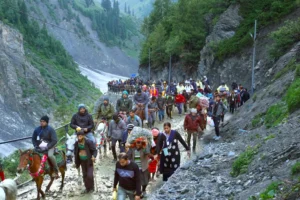
The journey to Holy Cave of Shri Amarnathji requires you to trek through mountain paths that reach heights of 14,800 feet above the ground.
Pilgrims may develop High Altitude Sickness that brings symptoms including: reduced hunger, feeling sick, throwing up, tiredness, body weakness, spinning feelings, lightheadedness and sleep troubles, unclear eyesight, difficulty passing urine, troubles with digestion, problems keeping your balance during walking, weakness on one half of your body, slowly losing awareness, confusion, sleepiness, chest discomfort, pressure, heaviness, quick breathing and your heart beating very fast.
Doctors must treat high altitude sickness right away, or it can become very dangerous and life-threatening within just a few hours.
Do’s for Prevention of High Altitude Sickness:
- You should prepare your body by building up your strength and fitness before the journey. Start taking walks of about 4-5 kilometers each morning or evening for at least one month before you leave for the Yatra.
- You should practice deep breathing routines and Yoga movements, especially pranayam techniques that help your body use oxygen better.
- You should talk with your doctor before you travel to higher mountains, especially if you have any health problems now or had them in the past.
- You should move your feet slowly when you go uphill and let your body get used to the height. Stop and rest for a few minutes on very steep parts of the path.
- You should not push your body harder than you normally do in everyday life.
- You should ask your doctor before you take any medicines or health products.
- You should drink plenty of water every day to prevent becoming thirsty and stop headaches from happening. Try to drink about 5 liters of fluid each day.
- You should eat lots of foods with carbohydrates to stop your body from getting tired and keep your blood sugar at the right level.
- You should bring a portable oxygen tank with you because it helps if you have trouble breathing during your climb.
- You should go down to a lower height right away if you feel symptoms of high altitude sickness starting to happen.
- If your health changes after a doctor checked you weeks before your journey, you should visit your doctor again before you start your pilgrimage.
- If you see any signs of high altitude sickness or feel uncomfortable, you should quickly reach a medical center at the different camps along the route.
Don’ts for Prevention of High Altitude Illness:
- You should never ignore the warning signs that show you have altitude sickness.
- You should never drink alcohol, beverages with caffeine, or smoke cigarettes.
- You should never climb higher if you feel altitude sickness. Instead, you must go down to a lower place where your body can adjust to the height.
- You should never believe everything a sick pilgrim tells you because their thinking becomes unclear.
Shri Amarnathji Yatra Public Interest Messages
Do’s for the Yatris:
- You should pack heavy woolen sweaters and jackets because the temperature sometimes drops very quickly to below 5 degrees Celsius.
- You should bring an umbrella, a wind-blocking jacket, a rain coat, and waterproof footwear because the weather changes without warning in this mountain area.
- You should put your clothes and snacks into waterproof bags so water does not soak your belongings during rain.
- You should keep a small paper in your pocket that shows the name, address, and phone number of another pilgrim going on the same date as you, in case you need help.
- You should carry your ID card or driving license along with your Yatra permission paper at all times.
- You should move forward in a group with guides, horses, or porters that carry your bags for you.
- You should watch that every person in your group stays where you can see them so nobody gets lost and separated.
- When you walk back home, you must leave from the Base Camps at the same time as everyone else in your group.
- You should ask the Police for quick help if someone from your group goes missing. You should also ask the camp speakers to announce about the missing person.
- You should give help to other pilgrims walking with you and complete your journey with a pure heart.
- You must always follow all the rules and directions that the Yatra leaders give you.
- You can get help from the SASB Camp Leaders or the nearest Yatra Help desk if you need anything.
- If something bad happens or you face an emergency, you must phone the nearest Camp Leader or Mountain Rescue Teams right away at the different camp spots.
- The Yatra area gives free meals to everyone at the Langar spots all along the route.
- Phone cards from other States may not work in Jammu & Kashmir and the Yatra places. Pilgrims can get ready-to-use phone cards at the Base Camps in Baltal and Nunwan and at Bhagwati Nagar near Jammu and Lakhanpur.
- Earth, water, air, fire and sky all form part of Lord Shiva’s power. Because of this, you must take care of nature and never do anything that harms or dirties the Yatra ground.
Don’ts for the Yatris:
- Women pilgrims should never wear sarees while trekking. Wearing loose pants with shirts, regular pants with shirts, or track suits works much better.
- Women who will have a baby within six weeks must not go on this pilgrimage.
- Children who have not reached 13 years of age yet and grown-ups older than 70 years cannot go on this pilgrimage journey.
- You should never stop at spots that show danger signs. You must only walk on marked paths.
- You should never go barefoot or without thick woolens at any point because the temperature stays very low and shifts rapidly.
- You should never use flip-flops or sandals because the mountain route goes up and down steeply. You must wear trekking shoes that have laces to keep them tight.
- You should never try taking shortcuts on the path because this brings real danger to your safety.
- You should never start your walk when your stomach is empty. Doing this can cause serious health troubles.
- You must never do anything during your entire journey that makes the land dirty or ruins the natural beauty of the region.
- You must never carry plastic bags because their use becomes illegal in Jammu & Kashmir and the law punishes this action.
- You must never throw coins, paper money, pretty scarves, metal pots, or any other things toward the Shivlingam when you visit and pray at the Holy Cave.
- You should never stay at the Holy Cave when night falls because the high mountain height and severe unpredictable weather make this very dangerous.
For Questions About Your Yatra Trip:
Call: 0191-2503399 and 0191-2555662 (Jammu)
Call: 0194-2313146, 0194-2313147-49 (Srinagar)
Toll-Free: 180018071987, 18001807199
Website: https://jksasb.nic.in
Conclusion
Preparing well and following these do’s and don’ts makes all the difference between a safe, memorable pilgrimage and a dangerous experience. Your body’s health, your group’s safety, and respect for nature all depend on your choices during this journey. By staying alert, preparing properly, and following camp instructions, you can complete your Amarnath Yatra 2026 successfully and create memories that last your entire lifetime.
Book here package: https://www.shrineyatra.in/amarnath-yatra-packages