
Which Route is Easier: Baltal or Pahalgam?
Quick Answer: Baltal route is shorter (14 kilometers one way) and can be completed in one day, making it physically easier for fit pilgrims. Pahalgam route is longer (48 kilometers one way) but offers gradual ascent over 3-5 days with better acclimatization, making it safer for elderly pilgrims and those concerned about altitude sickness. For most people, Baltal proves easier due to reduced walking distance despite steeper terrain.
Understanding Both Routes to Amarnath Cave
The sacred Amarnath Cave pilgrimage offers two distinct access routes through the Kashmir Himalayas. Each route presents unique challenges, advantages, and terrain characteristics that suit different pilgrim profiles.
Baltal serves as the northern base camp, providing a direct but steep approach to the holy cave. Pahalgam functions as the traditional southern base, offering the ancient pilgrimage path used for centuries.
Geographic Overview of Both Routes
Baltal sits at 2,743 meters altitude in the Ganderbal district, approximately 15 kilometers from Sonamarg. The route climbs steeply through narrow valleys and crosses challenging terrain to reach the cave at 3,888 meters.
Pahalgam lies at 2,740 meters altitude in the Anantnag district, serving as a popular tourist destination beyond its pilgrimage significance. The traditional route meanders through multiple campsites, gaining altitude gradually over several days.
Both routes converge at the Amarnath Cave shrine, where pilgrims worship the naturally formed ice Shivalinga that appears during summer months.
Also read: https://www.shrineyatra.in/how-to-reach-amarnath-yatra
Distance Comparison
The most obvious difference between routes lies in total trekking distance required.
Baltal Route Distance
The complete Baltal trek covers 14 kilometers from base camp to the holy cave. Most pilgrims complete this one-way journey in 4-6 hours depending on fitness levels and weather conditions.
Return journey adds another 14 kilometers, bringing total trekking distance to 28 kilometers. Fit pilgrims complete the round trip in a single day, returning to Baltal the same evening.
The short distance makes this route attractive for time-constrained pilgrims or those preferring concentrated physical effort over extended multi-day trekking.
Pahalgam Route Distance
The traditional Pahalgam route spans 48 kilometers from base camp to the shrine. This journey unfolds over 3-5 days with overnight stops at designated campsites.
Standard camping points:
- Chandanwari (Day 1): 16 kilometers from Pahalgam
- Sheshnag (Day 2): 13 kilometers from Chandanwari
- Panchtarni (Day 3): 13 kilometers from Sheshnag
- Amarnath Cave (Day 4): 6 kilometers from Panchtarni
Return journey retraces the same path, doubling total walking distance to 96 kilometers over 6-8 days including return.
The extended distance demands sustained endurance but distributes physical effort across multiple days rather than concentrated exertion.
Terrain and Difficulty Analysis
Distance alone does not determine route difficulty. Terrain characteristics significantly impact the actual trekking experience.
Baltal Route Terrain
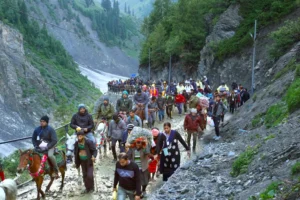
Baltal presents steep, continuous climbing from the start. The path ascends rapidly through narrow gorges and rocky sections that challenge even fit trekkers.
Altitude gain occurs quickly over short distance. Starting at 2,743 meters and reaching 3,888 meters means climbing 1,145 meters in just 14 kilometers. This translates to average gradient exceeding 8%, with sections steeper than 15%.
Rocky, uneven paths dominate much of the route. Loose stones and boulder sections require careful foot placement. The trail narrows in places, becoming precarious during crowded periods when thousands of pilgrims trek simultaneously.
Snow and ice persist on upper sections even during summer pilgrimage season. Slippery conditions increase fall risks, especially during descent when fatigue sets in and footing becomes less secure.
Pahalgam Route Terrain
Pahalgam offers gentler, more gradual ascent spread across multiple days. Daily elevation gains remain moderate, allowing your body to adjust progressively to increasing altitude.
The trail varies from well-maintained paths to rocky sections and stream crossings. Overall difficulty rates lower than Baltal’s relentless steepness, though several challenging segments exist.
Chandanwari to Sheshnag includes a strenuous uphill section nicknamed “Pissu Top” that tests endurance significantly. Sheshnag to Panchtarni crosses the highest point at approximately 4,200 meters before descending toward the cave.
Scenic beauty compensates for physical demands on the Pahalgam route. Alpine meadows, pristine lakes, snow-capped peaks, and diverse landscapes make the journey spiritually and aesthetically rewarding beyond just reaching the destination.
Altitude Considerations
Altitude sickness poses the primary health risk during Amarnath pilgrimage, making acclimatization strategies crucial.
Baltal Altitude Profile
Rapid altitude gain from 2,743 to 3,888 meters in 4-6 hours gives your body minimal time to adjust. Many pilgrims experience headaches, nausea, breathlessness, and dizziness during or after the Baltal trek.
Acute Mountain Sickness (AMS) symptoms appear more frequently on this route compared to Pahalgam. The quick ascent prevents proper acclimatization that gradual altitude gain provides.
Pilgrims arriving directly from plains regions (sea level to 500 meters) face highest AMS risk. Spending 1-2 days in Sonamarg (2,740 meters) before attempting the Baltal trek helps acclimatization but many pilgrims skip this precaution.
Pahalgam Altitude Profile
Gradual ascent over multiple days allows natural acclimatization. Your body adjusts progressively as you spend nights at intermediate altitudes before reaching maximum elevation.
Altitude progression:
- Pahalgam base: 2,740 meters
- Chandanwari camp: 2,895 meters
- Sheshnag camp: 3,574 meters
- Panchtarni camp: 3,845 meters
- Amarnath Cave: 3,888 meters
Sleeping at progressively higher elevations triggers physiological adaptations. Your body produces more red blood cells, improves oxygen utilization, and adjusts breathing patterns naturally.
AMS incidence remains significantly lower on Pahalgam route. The multi-day approach follows mountaineering wisdom of “climb high, sleep low” better than Baltal’s rapid ascent-descent pattern.
Time Requirements
Available vacation days often determine which route pilgrims choose.
Baltal Time Commitment
Complete the Baltal route in minimum 2 days total:
- Day 1: Reach Baltal from Srinagar (3-4 hours drive)
- Day 2: Trek to cave and return to Baltal same day
- Day 3: Return to Srinagar
Most pilgrims allocate 3-4 days including travel to/from Srinagar and buffer for weather delays. This compressed timeline suits working professionals with limited leave.
The single-day trek means one night accommodation at Baltal only. Reduced camping nights mean lower costs and simpler logistics compared to multi-day camping on Pahalgam route.
Pahalgam Time Requirements
Traditional Pahalgam route demands minimum 6-8 days:
- Day 1: Reach Pahalgam from Srinagar (3 hours drive)
- Days 2-4: Trek to cave via Chandanwari, Sheshnag, Panchtarni
- Days 5-7: Return trek to Pahalgam
- Day 8: Return to Srinagar
Many pilgrims take 8-10 days for comfortable pacing with rest days. This extended commitment challenges those with strict time constraints or limited vacation availability.
Multiple nights camping at high altitude requires more extensive gear, provisions, and planning. However, the journey itself becomes a significant part of the pilgrimage experience rather than just a means to reach the shrine.
Physical Fitness Requirements
Each route demands different fitness capabilities and preparation approaches.
Baltal Fitness Demands
Baltal requires good cardiovascular fitness and strong leg muscles for sustained steep climbing. The compressed timeframe means no rest opportunities until completing the entire ascent.
Young, fit pilgrims handle Baltal better than elderly or less active individuals. The route rewards athletic capability with quick completion, but punishes inadequate fitness with severe exhaustion.
Downhill return journey stresses knees significantly. The steep descent on tired legs causes joint pain and increases injury risk, especially for people with existing knee problems.
Training for Baltal should emphasize:
- Stair climbing with weighted backpack
- High-intensity interval training
- Leg strengthening exercises (squats, lunges)
- Cardiovascular endurance building
Pahalgam Fitness Requirements
Pahalgam suits moderate fitness levels better. Daily walking distances of 10-16 kilometers remain manageable for reasonably active people including seniors who maintain regular walking routines.
The multi-day format allows rest and recovery each evening. Tired pilgrims still complete their daily segment, rest overnight, and begin fresh next morning rather than pushing through exhaustion.
Endurance matters more than peak fitness. Ability to walk consistently for 5-7 hours daily across multiple consecutive days determines success better than sprint-like athletic capability.
Pahalgam training should focus on:
- Progressive distance walking (building to 15 kilometers)
- Multi-day consecutive walking without extended rest
- General cardiovascular conditioning
- Flexibility and stretching for injury prevention
Weather and Seasonal Factors
Both routes face challenging Himalayan weather, but timing and exposure differ.
Baltal Weather Exposure
Single-day trek limits weather risk window but concentrates it intensely. If conditions deteriorate during your trek day, you face difficult decisions about pushing forward or turning back.
Early morning departures (3-4 AM) help avoid afternoon thunderstorms common in mountains. However, pre-dawn starts mean trekking in darkness initially, requiring flashlights and careful navigation.
The route passes through areas prone to sudden weather changes. Fog rolls in quickly, obscuring paths. Rain transforms sections into slippery hazards within minutes.
Winter snowfall persists longer at higher elevations on north-facing Baltal route. Ice and snow conditions may exist even during July-August pilgrimage season, requiring crampons or micro-spikes for safe passage.
Pahalgam Weather Considerations
Multi-day exposure means weather affects you across multiple days. Extended bad weather can disrupt the entire pilgrimage, trapping pilgrims at intermediate camps.
However, the traditional route’s gentle gradient makes it safer to continue in marginal weather compared to steep Baltal sections where rain creates dangerous slippery conditions.
Camping infrastructure on Pahalgam route provides better shelter from weather. Established campsites with dining tents and toilet facilities offer comfort that day-tripping Baltal pilgrims lack.
Weather windows matter less on Pahalgam route because you are committed for multiple days regardless. One bad weather day among five total days impacts experience less than bad weather on your single Baltal trek day.
Safety and Medical Facilities
Health emergencies in mountains require immediate access to medical assistance.
Baltal Safety Infrastructure
Medical camps operate at Baltal base and at the midway point (Domail). Doctors and basic emergency equipment remain available throughout pilgrimage season.
Helicopter evacuation services operate from Baltal for serious medical emergencies. The shorter distance to the cave means rescue operations complete faster than from remote Pahalgam route campsites.
However, the steep terrain complicates evacuations. Injured or sick pilgrims on the trail face difficult extraction even with pony or palanquin assistance.
The compressed timeframe of Baltal means medical problems that develop during trek allow little time for rest and recovery before attempting descent. Pushing through illness or injury often worsens conditions.
Pahalgam Safety Infrastructure
Medical facilities exist at Pahalgam base, Chandanwari, Sheshnag, and Panchtarni camps. This distributed medical presence means help remains within 6-8 kilometers at most points on the route.
The gradual route allows sick pilgrims to rest at current location and continue after recovery. No pressure exists to complete entire trek in one day, reducing tendency to push beyond safe limits.
Helicopter rescue operates but faces challenges in some sections where suitable landing zones do not exist. Evacuations from remote campsites can take longer than from the more accessible Baltal route.
Larger camping populations mean more medical staff and better equipment at Pahalgam route camps compared to smaller Baltal installations.
Cost Comparison
Financial considerations influence route selection for budget-conscious pilgrims.
Baltal Route Costs
Lower overall costs due to shorter duration and minimal camping requirements. Total expenses range from ₹5,000-₹8,000 per person for basic pilgrimage.
Cost breakdown:
- Registration and insurance: ₹150-₹300
- Transport to Baltal: ₹1,000-₹2,000
- One night accommodation: ₹500-₹1,500
- Meals: ₹500-₹1,000
- Pony/palanquin (if needed): ₹2,500-₹4,000
- Miscellaneous: ₹500-₹1,000
No camping equipment rental needed since the trek completes in one day. This eliminates costs for sleeping bags, tents, and other multi-day trekking gear.
Pahalgam Route Costs
Extended duration increases total pilgrimage costs to ₹12,000-₹20,000 per person for the traditional trek experience.
Cost breakdown:
- Registration and insurance: ₹150-₹300
- Transport to Pahalgam: ₹1,500-₹3,000
- Multiple nights accommodation/camping: ₹3,000-₹6,000
- Meals across multiple days: ₹2,000-₹4,000
- Pony/porter services: ₹4,000-₹8,000 (if used entire route)
- Equipment rental: ₹1,000-₹2,000
- Miscellaneous: ₹1,000-₹2,000
Budget pilgrims choosing Pahalgam must commit significantly more funds than those taking Baltal route. However, the enhanced experience and safety justify higher costs for many.
Crowd Levels and Congestion
Pilgrimage popularity means both routes face heavy foot traffic during peak season.
Baltal Crowds
Baltal attracts large numbers due to its quick completion advantage. Thousands attempt the trek daily during peak season, creating congestion on narrow trail sections.
Bottlenecks form at difficult sections where pilgrims slow down. Overtaking becomes challenging and sometimes impossible on narrow ledges and steep sections.
The single-day format means all Baltal pilgrims crowd the route simultaneously rather than spreading out across multiple days like Pahalgam trekkers.
Starting very early (3-4 AM) helps avoid worst congestion. Pilgrims departing at sunrise encounter heavy traffic throughout the trek as waves of pilgrims converge.
Pahalgam Crowds
Pahalgam spreads pilgrims across the route over multiple days. While total numbers may match Baltal, the distribution across 48 kilometers and multiple camping stages reduces per-section congestion.
Chandanwari experiences heaviest crowding as all pilgrims pass through on Day 1. Subsequent segments see thinner crowds as groups proceed at different paces.
Camping areas become crowded during peak season. Finding good tent locations and dealing with camp congestion can prove frustrating, though organized camping reduces chaos.
The traditional route’s cultural significance attracts pilgrims who value the spiritual journey as much as the destination. This creates different crowd dynamics than Baltal’s efficiency-focused trekkers.
Pony and Palanquin Availability
Physical assistance options exist on both routes for those unable to complete treks on foot.
Baltal Assistance Options
Ponies available from Baltal to cave cost ₹2,500-₹4,000 for round trip. Availability fluctuates based on demand, requiring early booking during peak periods.
Palanquins (dolis) provide options for elderly or disabled pilgrims. Four porters carry these traditional sedan chairs for ₹5,000-₹8,000 round trip.
The steep terrain challenges ponies and palanquin carriers. Services may refuse transport during bad weather or for extremely heavy passengers due to safety concerns.
Helicopter services operate from Panchtarni (6 kilometers from cave) for pilgrims who helicopter from Baltal to Panchtarni, then pony/walk the final section. This costs ₹3,500-₹5,000 one way.
Pahalgam Assistance Availability
Extensive pony operations support the traditional route. Ponies available for individual segments or the complete journey from Pahalgam to cave.
Approximate pony costs:
- Pahalgam to Chandanwari: ₹1,200-₹1,800
- Chandanwari to Sheshnag: ₹1,500-₹2,200
- Sheshnag to Panchtarni: ₹1,500-₹2,200
- Panchtarni to Cave: ₹800-₹1,200
- Complete journey: ₹6,000-₹10,000
Palanquin services cost roughly double pony rates. Porter services for carrying luggage cost ₹1,000-₹2,000 per day per porter.
The gradual terrain makes pony transport safer and more comfortable on Pahalgam route compared to steep Baltal sections where ponies struggle and passengers feel precarious.
Cultural and Spiritual Aspects
Beyond physical considerations, each route offers different spiritual experiences.
Baltal Modern Approach
Baltal represents the modern, efficient pilgrimage style. Focus remains on reaching the shrine, completing darshan, and returning quickly.
Limited time at intermediate locations reduces opportunities for meditation, reflection, and spiritual immersion in the Himalayan environment.
The route attracts younger pilgrims, working professionals, and those viewing pilgrimage primarily as destination achievement rather than transformative journey.
However, Baltal efficiency allows pilgrims with genuine time constraints to complete the holy pilgrimage when the traditional multi-day commitment would make it impossible.
Pahalgam Traditional Journey
Pahalgam preserves the ancient pilgrimage tradition where the journey itself constitutes the spiritual practice. Multi-day trekking becomes moving meditation through sacred landscapes.
Camping under Himalayan stars, sharing meals with fellow pilgrims, and experiencing the mountains’ grandeur for days creates profound spiritual impact beyond just shrine darshan.
The route passes Sheshnag Lake, named after the mythical serpent that serves as Lord Shiva’s seat. Pilgrims circumambulate this sacred lake as part of traditional rituals.
Elderly pilgrims often prefer Pahalgam despite longer duration because the traditional route connects them with generations of ancestors who walked the same path for centuries.
First-Timer Recommendations
Pilgrims undertaking Amarnath Yatra for the first time face difficult choices without prior experience.
When to Choose Baltal
Select Baltal route if you:
- Have limited vacation time (4-5 days maximum)
- Possess good physical fitness and hiking experience
- Want to minimize costs
- Handle altitude changes well based on previous mountain experience
- Travel during peak season when Pahalgam route faces severe overcrowding
- Feel comfortable with challenging, steep terrain
When to Choose Pahalgam
Select Pahalgam route if you:
- Can allocate 8-10 days for the complete pilgrimage
- Have moderate fitness but not athletic conditioning
- Prefer gradual acclimatization over rapid altitude gain
- Value the journey experience as much as shrine darshan
- Are over 55 years old or have health concerns
- Have never trekked at high altitude before
- Want traditional pilgrimage experience with cultural immersion
Elderly Pilgrim Considerations
Age brings wisdom but also physical limitations requiring careful route evaluation.
Baltal for Seniors: Challenges
The steep, demanding Baltal trek challenges older pilgrims significantly. Knee stress during descent often proves more problematic than the uphill climb.
Rapid altitude gain increases AMS risk for elderly pilgrims whose bodies adapt more slowly to environmental changes than younger people.
Single-day exertion without overnight rest between ascent and descent exhausts older bodies that need recovery time between major physical efforts.
Seniors with good fitness who regularly engage in challenging hiking can succeed on Baltal, but most elderly pilgrims face serious difficulties on this route.
Pahalgam for Seniors: Advantages
The gradual, multi-day format suits older pilgrims much better. Daily segments remain manageable for seniors who walk regularly even if peak fitness has declined.
Rest periods between trekking days allow recovery. Seniors can push through one day’s walking knowing a full night’s rest precedes tomorrow’s effort.
Pony services become more economical on Pahalgam route for elderly pilgrims who use ponies for the entire journey rather than just short Baltal sections.
Many pilgrims in their 70s and even 80s complete Pahalgam route successfully using pony assistance and taking extra rest days, while Baltal would prove impossible for the same individuals.
Weather Window Reliability
Unpredictable mountain weather affects both routes but impacts them differently.
Baltal Weather Dependency
Your entire pilgrimage success depends on weather during one critical 24-hour window. Bad weather on your planned trek day might mean missing the shrine completely if you cannot wait additional days.
No partial success exists on Baltal. You either complete the full round trip or fail entirely. No intermediate campsites allow you to wait out bad weather midway.
Pilgrims with flexible schedules handle this better than those with fixed return tickets or work commitments requiring departure on specific dates.
Pahalgam Weather Flexibility
Multi-day journey allows weather flexibility. One or two bad weather days among five total trek days rarely prevent shrine darshan completely.
Rest days can be inserted when weather turns particularly bad. Continue trekking when conditions improve rather than forcing movement through dangerous weather.
However, extended bad weather lasting 3-4 days can disrupt the entire Pahalgam pilgrimage, potentially preventing shrine access while consuming time and resources.
Environmental Considerations
Both routes impact the fragile Himalayan ecosystem, but in different ways.
Baltal Environmental Impact
Concentrated daily traffic damages vegetation and trail surfaces along the short route. Thousands of footsteps daily compact soil, kill plants, and create erosion.
Single-day trash generation gets concentrated at Baltal base and along the 14-kilometer path. Inadequate waste management means litter accumulates despite cleanup efforts.
Pony droppings concentrate on the narrow trail. The steep terrain makes pony waste management challenging, creating sanitation and aesthetic problems.
Pahalgam Environmental Spread
Wider distribution of pilgrims reduces per-location environmental stress compared to Baltal’s concentrated impact. Multiple campsites spread the burden.
However, absolute numbers and extended presence mean cumulative environmental damage potentially exceeds Baltal despite lower density.
Camping waste poses challenges across multiple locations. Each campsite requires waste management systems, toilet facilities, and grazing areas for ponies supporting the route.
Technical Trek Ratings
Mountaineering difficulty scales help objectively compare route challenges.
Baltal Technical Rating
Distance: 14 kilometers one way (28 kilometers round trip)
Duration: 4-6 hours ascent, 3-5 hours descent
Elevation Gain: 1,145 meters
Difficulty Grade: Moderate to Difficult
Technical Skills Required: Basic mountain trekking ability
Fitness Level Required: Good to Excellent
The route qualifies as genuine mountain trekking rather than casual hiking. Prior high-altitude experience significantly improves success probability.
Pahalgam Technical Rating
Distance: 48 kilometers one way (96 kilometers round trip)
Duration: 3-5 days ascent, 2-4 days descent
Maximum Elevation: 4,200 meters at highest pass
Difficulty Grade: Easy to Moderate
Technical Skills Required: Basic walking ability
Fitness Level Required: Moderate to Good
The traditional route rates easier on daily difficulty scale despite longer total distance. Manageable daily segments mean less technical ability required.
Registration and Permit Requirements
Administrative processes affect both routes similarly with minor variations.
Common Registration Process
All Amarnath pilgrims must complete Compulsory Health Certificate (CHC) registration through designated banks. Medical examination confirms fitness for high-altitude pilgrimage.
Registration includes ₹150 pilgrim fee and insurance coverage for emergency evacuations and medical treatment during the pilgrimage period.
Route-Specific Considerations
Choose your intended route during registration as permit allocation happens separately for Baltal and Pahalgam routes. Changing routes after registration causes administrative complications.
Baltal permits often remain more available due to higher turnover from single-day completion. Pahalgam permits may face restrictions during peak periods when camping capacities reach limits.
Making Your Final Decision
Evaluate your situation honestly across multiple dimensions:
Choose Baltal if: Time constraints exceed fitness concerns, you have strong athletic ability, budget limitations matter significantly, and quick completion takes priority over extended spiritual experience.
Choose Pahalgam if: Safety through gradual acclimatization matters most, you value traditional pilgrimage journey, moderate fitness but strong determination describes you, and adequate vacation time permits multi-day commitment.
Hybrid Option: Some pilgrims helicopter to Panchtarni from either base, then trek the final 6 kilometers. This eliminates major trekking challenges while retaining some traditional walking experience.
Summary: Easier Route Depends on Your Definition
Baltal proves easier for fit pilgrims seeking quick completion with minimal time investment. The short distance and one-day format provide clear efficiency advantages despite steep, challenging terrain.
Pahalgam proves easier for elderly pilgrims, those concerned about altitude sickness, and people valuing safety through gradual acclimatization. The extended timeline distributes physical demands across multiple manageable days.
Neither route qualifies as “easy” in absolute terms. Both demand significant physical effort, mental determination, and resilience facing challenging mountain conditions.
The sacred Amarnath pilgrimage rewards all sincere devotees regardless of chosen route. Select the path matching your physical capabilities, time availability, and spiritual approach rather than chasing an imaginary “easier” option that works universally for everyone.
Book #Amarnath package: https://www.shrineyatra.in/amarnath-yatra-packages