Amarnath Weather – Complete Month-by-Month Guide for Pilgrims (2026)
A complete, honest breakdown of weather conditions at Amarnath Cave (3,888 m) – what the temperature actually feels like, when the rains hit, when the snow falls, and exactly what to pack for each season.
Amarnath Weather – Key Facts at a Glance
- Altitude: 3,888 m (12,756 ft) – weather changes faster than at any plains destination
- Yatra Season Temperature: 2°C to 15°C (July to August)
- Rain Risk: High during monsoon (July–August) – afternoon cloudbursts are common
- Snow Season: November to April – cave is inaccessible, yatra closed
- Key Hazard: Weather can shift from sunny to snowfall within 30 minutes at this altitude
Why Amarnath Weather Is Unlike Any Other Destination in India?
Most tourists in India track weather to decide between a light jacket or an umbrella. At Amarnath, weather is a matter of survival.
The Amarnath Cave sits at 3,888 metres above sea level in the Lidder Valley of Jammu and Kashmir. At this altitude, the atmosphere holds significantly less heat, UV radiation is more intense, and storm systems develop and collapse with little warning. A clear blue morning can turn into a blinding snowstorm by early afternoon. A gentle drizzle at base camp can mean a dangerous whiteout near the cave.
This is not an exaggeration meant to intimidate — it is the mountain’s reality, and every pilgrim and trekker must understand it before setting foot on the trail. The SASB suspends the yatra during severe weather precisely because experienced mountaineers know how fast conditions can turn fatal at high altitude.
This guide gives you an honest, detailed picture of Amarnath weather month by month – not just average temperatures, but what those numbers feel like on your skin at 3,888 metres, and exactly how to prepare for them.
Amarnath Weather by Season – Overview
- Summer (May–June): Snow melting, trails opening, cool and clear — pre-yatra window
- Monsoon / Yatra Season (July–Aug): Yatra in full swing — pleasant days, risky afternoons, carry rain gear always
- Post-Monsoon (Sep–Oct): Yatra closed — trails begin to ice over, winter approaching fast
- Winter (Nov–Apr): Extreme cold, heavy snowfall, cave fully inaccessible — do not attempt
Amarnath Weather During the Yatra Season (July – August)
The yatra season aligns with the only safe weather window of the year at Amarnath. SASB and the Indian Meteorological Department jointly determine the exact opening and closing dates each year based on snowpack conditions and forecast stability. The 2026 yatra runs from July 3 to August 9.
July — Peak Season Weather
July is the best month to experience the Amarnath Yatra from a weather perspective. The ice Shivling is at its maximum natural formation, and daytime temperatures hover between 8°C and 15°C during morning trek hours. Skies are often clear between 4 AM and 11 AM — the ideal trekking window.
- Morning (4 AM to 9 AM): 3 to 8°C — cold, crisp, often with frost on the ground
- Midday (10 AM to 1 PM): 10 to 15°C — the most comfortable trekking window
- Afternoon (after 1 PM): Rapid cloud build-up. Rain or hail likely by 2 to 3 PM
- Night at high camps (Sheshnag, Panchtarni): 0 to 5°C — thermal layers and sleeping bag essential
The Golden Rule of Amarnath Trekking Weather
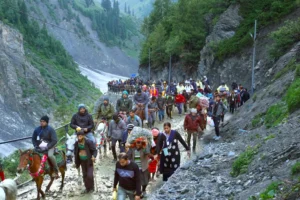
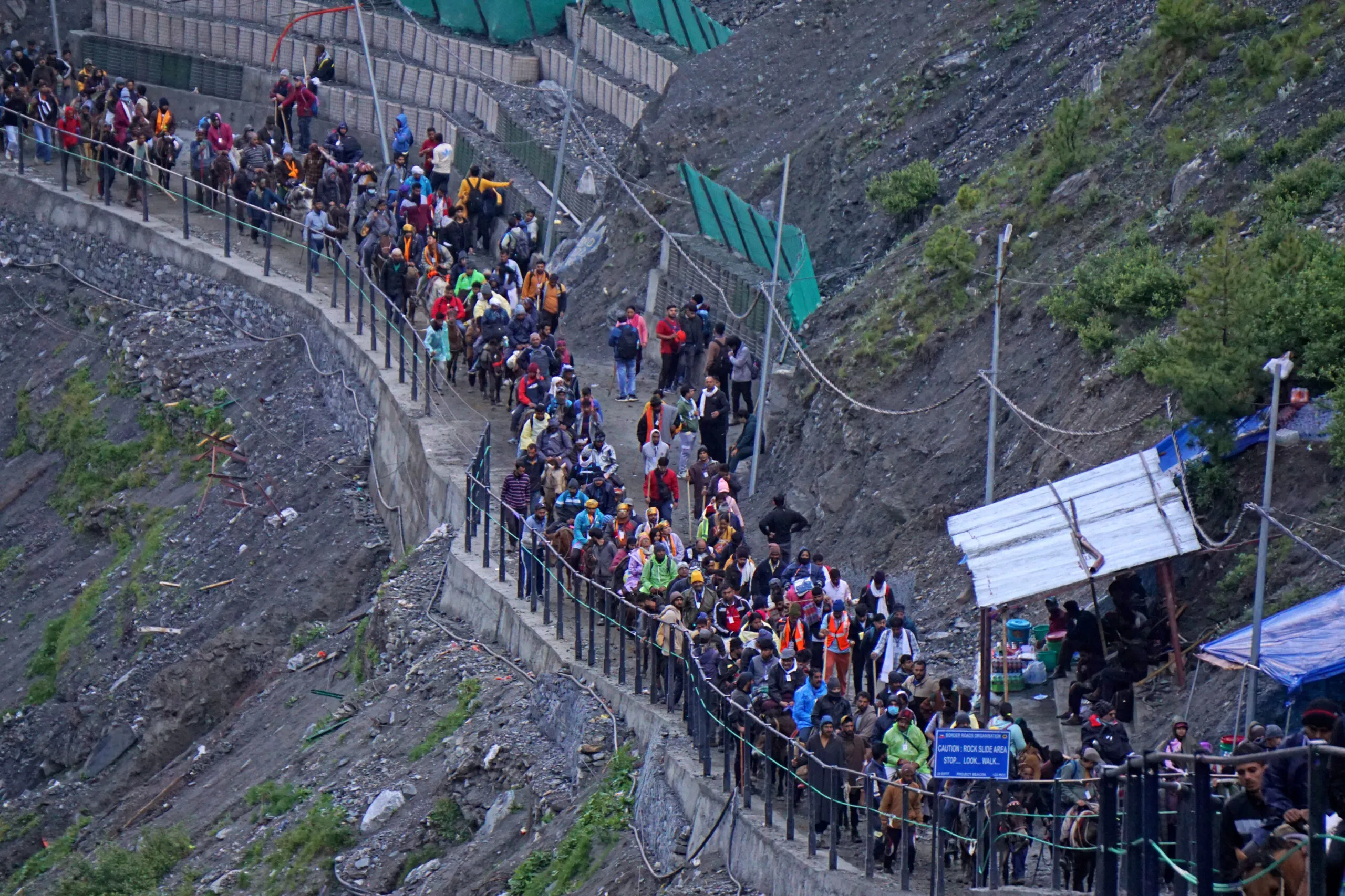
Start every trek day before 6 AM. Reach your campsite or complete your darshan before 1 PM. The mountain’s afternoon weather is not a suggestion — it is a hard boundary. Afternoon cloudbursts on the Pahalgam and Baltal trails cause flash flooding at river crossings and turn loose-stone paths into rivers of mud. Experienced pilgrims do not negotiate with this rule.
August — Closing Month Weather
August brings the heaviest monsoon influence to Amarnath. Rain is more frequent, trail conditions are muddier, and the yatra officially closes in early August (August 9 in 2026). The ice Shivling diminishes in August as the lunar cycle wanes — darshan remains deeply moving, but the Shivling is smaller than in July.
- Daytime temperature: 8 to 15°C, similar to July but with higher humidity
- Rain frequency: Higher than July — expect 3 to 4 rain events per week
- Cloudburst risk: Elevated — do not trek without a waterproof poncho
- Night temperature: Near 0°C at Sheshnag and Panchtarni camps
- Visibility: Can drop to near zero during monsoon cloud episodes
Monsoon Risk Warning — August: Cloudbursts — sudden, extremely intense localized rainfall — have historically caused trail damage and emergency evacuations on both Pahalgam and Baltal routes in August. SASB may suspend the yatra for 24 to 72 hours during severe weather events. Build buffer days into your travel plan. Never push forward on a suspended trail.
Amarnath Weather Month by Month — Complete Temperature Data
|
|
|||
|---|---|---|---|
| Month | Temperature (Day/Night) | Conditions | Yatra Status |
| January | 0°C / -5°C | Heavy Snow | Closed — Entire region buried in snow. Cave completely inaccessible. |
| February | -1°C / -5°C | Heavy Snow | Closed — Coldest month. Dangerous conditions. No access under any circumstances. |
| March | 1°C / 0°C | Snow/Overcast | Closed — Temperatures begin rising minimally. Snow still covers all passes. |
| April | 4°C / 2°C | Partly Cloudy | Closed — Snow slowly melting at lower levels. High trails still impassable. |
| May | 10°C / 3°C | Clear/Cool | Closed — Trails starting to open. Pleasant days but cold nights. Pre-trek prep month. |
| June | 14°C / 7°C | Clear/Warm | Pre-Yatra — Ideal acclimatization month. Landscape blooming. Yatra begins July 3. |
| July | 15°C / 3°C | Mixed/Monsoon | OPEN – Peak — Best month. Shivling at maximum. Trek mornings only. Afternoon rain/hail. |
| August | 15°C / 5°C | Monsoon | OPEN – Closing — Yatra closes August 9. Heavier rain, muddier trails. Ice Shivling diminishing. |
| September | 12°C / 4°C | Cool/Clear | Closed — Yatra over. Trails icing. Winter approaching fast. |
| October | 12°C / 5°C | Cold/Overcast | Closed — Winter setting in. Snow accumulating. Roads to cave closing. |
| November | 4°C / 0°C | Heavy Snow | Closed — Severe cold. Region inhospitable. Do not attempt any trek. |
| December | 1°C / -3°C | Heavy Snow | Closed — Deep winter. Roads snow-covered. Cave sealed under snow. |
Amarnath in Summer (May – June) — Pre-Yatra Window
May and June mark the transition from winter to the pilgrimage season at Amarnath. The heavy snowpack of winter begins to melt, and the high-altitude meadows return to green. Trail crews and SASB teams move in to clear paths, establish medical camps, and prepare the infrastructure that supports lakhs of pilgrims.
For pilgrims planning the yatra, June is the ideal month to arrive in the Kashmir Valley. Pahalgam and Srinagar are at their most beautiful — wildflowers in bloom, rivers running strong with glacial meltwater, and the air carrying that particular cool crispness Kashmir is famous for. Acclimatizing in Pahalgam for 2 to 3 days in late June before the July 3 yatra opening is ideal.
- Average daytime temperature in Pahalgam in June: 20 to 24°C
- Temperature at cave level in June: 7 to 14°C — still cold
- Snowfields at Chandanwari are active in May and June — carry trekking poles
- June rainfall is light compared to July and August — generally clear mornings
Amarnath in Winter (November – April) — Extreme Conditions
The Amarnath Cave is completely inaccessible during winter. This is not a matter of permit or regulation alone — it is a physical impossibility. The passes leading to the cave receive several metres of snowfall between November and April. Temperatures drop to -5°C and lower. Avalanche risk is high. No rescue services, no medical camps, and no trail infrastructure exist during this period.
Do Not Attempt Amarnath in Winter: Every year, individuals attempt to reach the Amarnath Cave outside the official yatra period. The outcomes are consistently severe. SASB explicitly prohibits off-season access. The Indian Army and CRPF enforce this restriction. The mountain’s winter is not a challenge to overcome — it is a boundary the mountain itself sets.
What to Wear for Amarnath Weather — Complete Packing Guide
- Thermal innerwear (top and bottom): Wear every day, regardless of midday warmth
- Waterproof, windproof outer jacket: Non-negotiable; mountain rain soaks cotton within minutes
- Fleece or wool mid-layer: For mornings and evenings when temperature drops fast
- Waterproof trekking trousers: Avoid denim entirely (heavy when wet, cold against skin)
- Ankle-support waterproof trekking boots: Trail mud and stream crossings are unavoidable
- Wool socks — 4 pairs minimum: Wet socks cause blisters and cold injury
- Rain poncho: Folds into a pocket; deploy when clouds start building (usually by 11 AM)
- Gloves: Lightweight liner gloves for mornings; warmer gloves for high camps at night
- Warm cap or balaclava: Head and neck lose heat fastest at altitude
- UV-protection sunglasses: UV intensity at 3,888 m is significantly higher than at sea level
- Sunscreen SPF 50+: Essential even on overcast days; clouds do not block UV at altitude
How Altitude Changes Everything — Amarnath Weather vs. Temperature Perception
A temperature of 8°C in Delhi feels cool but manageable. The same 8°C at 3,888 metres on the Amarnath trail feels significantly colder for three key reasons every pilgrim should understand.
- Wind Chill: Wind speed increases with altitude. A 15 km/h wind at 8°C feels like -2°C on exposed skin. On ridge crossings like Mahagunas Pass (4,890 m), winds can exceed 40 km/h.
- Lower Humidity: At altitude, the air carries very little moisture. This accelerates evaporative heat loss from skin and breathing. You lose body heat faster than at sea level, even when the thermometer reads the same.
- Reduced Oxygen: The body works harder to breathe at altitude, generating less internal warmth. Pilgrims from plains cities feel cold more quickly than their body temperature would suggest.
- Solar Intensity: UV radiation is 25 to 50% stronger at altitude. Overcast days do not reduce UV significantly. Sunburn and snow blindness are real risks even when you do not feel hot.
The Wind and Rain Combination Is the Most Dangerous
Most weather-related medical emergencies on the Amarnath Yatra are caused by wet + cold + wind together, not extreme cold alone. When a pilgrim is wet from rain, tired from trekking, and exposed to a 20 km/h ridge wind, hypothermia can develop within 60 to 90 minutes even at 10°C. A waterproof outer layer is not a luxury. It is the single most important piece of equipment on the Amarnath trail.
Hour-by-Hour Weather Pattern During the Amarnath Trek (Typical July Day)
|
|
|
|---|---|
| Time | Conditions |
| 3:30 AM – 5:00 AM | Coldest part of the day. 2 to 5°C at high camps. Clear, dark, stars visible. Ideal departure time. |
| 5:00 AM – 8:00 AM | Temperature rising slowly. 5 to 10°C. Light wind. Best trekking conditions of the day. |
| 8:00 AM – 11:00 AM | Warming to 12 to 15°C. Low cloud starting to build in some valleys. Still safe and pleasant. |
| 11:00 AM – 1:00 PM | Cloud build-up accelerating. Possible light drizzle beginning. Poncho should be accessible. |
| 1:00 PM – 3:00 PM | High risk window. Monsoon clouds can unleash heavy rain, hail, or sudden snowfall near the cave. |
| 3:00 PM – 6:00 PM | Rain usually heaviest. Trail slippery. River crossings may be swollen. Pilgrims should be in camp. |
| 6:00 PM – Night | Weather often clears partially. Temperature dropping fast. Thermal layers needed by 7 PM. |
When Does SASB Suspend the Amarnath Yatra Due to Weather?
The SASB and Indian Meteorological Department (IMD) jointly monitor real-time weather at multiple points along both the Pahalgam and Baltal routes. When specific thresholds are crossed, the yatra is suspended — pilgrims are held at base camps and not permitted to advance.
- Snowfall above Panchtarni or near the cave — suspension until trail is cleared
- Cloudburst warnings from IMD for the Lidder Valley region
- Flash flood risk at river crossings on the Pahalgam route
- Avalanche risk near Mahagunas Pass on the Pahalgam route high section
- Zero visibility conditions on either trail
Suspensions can last 6 hours, 24 hours, or occasionally 48 to 72 hours. SASB announces suspensions via the official SASB website, helpline 1800-180-7444, and through camp managers on both routes.
Planning Advice: Always Build 1 to 2 Buffer Days
Weather-related suspensions are not rare events — they happen multiple times every yatra season. If your entire trip is planned to the hour with no flexibility, a single weather day will cause you to miss darshan entirely. Book return travel (flights, trains) 2 days after your planned trek completion date. This is the single most consistent piece of advice from veteran Amarnath pilgrims.
Acclimatization and Amarnath Weather — Why Both Matter Together
The combination of altitude and sudden weather change is what creates medical emergencies on the Amarnath Yatra, not either factor alone. A well-acclimatized pilgrim handles a sudden temperature drop far better than one who arrived directly from a plains city the day before.
- Spend a minimum of 2 full days in Pahalgam (2,740 m) or Srinagar (1,585 m) before starting the trek
- Do not fly directly into Srinagar from a sea-level city and start trekking the same day
- Drink 3 to 4 litres of water daily during acclimatization — dehydration worsens cold sensitivity
- Avoid alcohol for 48 hours before and during the trek — it accelerates heat loss from the body
- If you develop a persistent headache during your acclimatization stay, do not proceed to the trailhead
Frequently Asked Questions – Amarnath Weather
Q1. What is the temperature at Amarnath during the yatra?
During the yatra season (July to August), daytime temperatures near the Amarnath Cave range from 8 to 15°C. Nights at high-altitude campsites drop to 0 to 5°C. Early morning trek hours feel between 3 and 8°C. Wind chill at ridge crossings can make these temperatures feel several degrees colder than the thermometer shows.
Q2. Does it rain during the Amarnath Yatra?
Yes — the Amarnath Yatra falls during India’s monsoon season (July to August). Afternoon rain is common on most days of the trek. Cloudbursts — sudden, intense localized rainfall — are a seasonal hazard and can cause trail damage or temporary yatra suspension. Carry a waterproof poncho and outer jacket at all times on the trail.
Q3. Can it snow during the Amarnath Yatra?
Yes. Snowfall can occur at or above the Amarnath Cave level (3,888 m and above) even in July and August. High-altitude passes like Mahagunas Pass (4,890 m on the Pahalgam route) can receive snowfall at any time during the yatra season. This is one reason the yatra is occasionally suspended for 24 to 48 hours. Pack thermal layers regardless of season.
Q4. Is Amarnath accessible in winter?
No. The Amarnath Cave is completely inaccessible from November to April. Heavy snowfall seals all approach routes, temperatures drop to -5°C and below, and no rescue or support infrastructure is in place. SASB and the CRPF enforce this restriction. Attempting to reach the cave outside the official yatra season is life-threatening and illegal.
Q5. What is the best month to visit Amarnath?
July is the best month to visit Amarnath. The ice Shivling is at its largest natural formation, weather conditions are slightly more stable than August, and the spiritual atmosphere of the yatra is at its peak. Register early — July trek slots sell out weeks in advance.
Q6. What should I pack for Amarnath weather?
The essentials are: thermal innerwear (top and bottom), a waterproof windproof outer jacket, a fleece or wool mid-layer, waterproof trekking trousers, ankle-support trekking boots, wool socks (4 pairs minimum), gloves, a warm cap, and a rain poncho. Sunscreen SPF 50+ and UV-protection sunglasses are essential even on overcast days. Do not substitute any of these with cotton alternatives.
Q7. What time of day is safest for trekking to Amarnath?
The safest trekking window is 4 AM to 12 PM. Depart camp as early as 3:30 to 4:00 AM to reach the cave or the next campsite before afternoon weather deteriorates. Monsoon cloud build-up typically begins around 11 AM, and rain is most likely between 1 PM and 5 PM. SASB and experienced guides consistently advise completing the day’s walking before midday.
Q8. What happens if the yatra is suspended due to bad weather?
If SASB suspends the yatra due to weather, pilgrims are held at their current camp or base camp until conditions improve. Food, shelter, and medical support remain available at official camps. Suspensions typically last 6 to 72 hours. Do not attempt to proceed on a suspended trail. Build 1 to 2 buffer days into your travel plan to accommodate potential suspensions.
Understanding Amarnath Weather Is Part of the Pilgrimage
The Amarnath Cave’s weather is not an obstacle to be overcome — it is part of the experience. Pilgrims who trek through cold morning air, shelter from an afternoon cloudburst, and emerge to a clearing sky above a glacial valley understand something about the mountain that those who only see photographs do not.
Respect the weather. Prepare for the weather. And trust that the mountain, for all its severity, has been welcoming pilgrims safely for over two thousand years — because those pilgrims came prepared, came in the right season, and came with the right state of mind.
If you are planning for Amarnath yatra, book here https://www.shrineyatra.in/amarnath-yatra-packages